
Colored gemstone jewelry is on a massive rise in 2026, and we couldn’t be happier about it!
There are several keys to building a colored gemstone jewelry collection that you are absolutely in love with.
Whether you’re building a fine jewelry collection for the first time or simply want to acquire more colored gemstone pieces, the first piece of advice we’d give is to find one ring, pair of earrings, and one necklace that you could wear day in, day out. Three staples that are versatile, comfortable, and look cute with everything so you can throw them on all the time without thinking about it.
Pieces We’d Recommend:
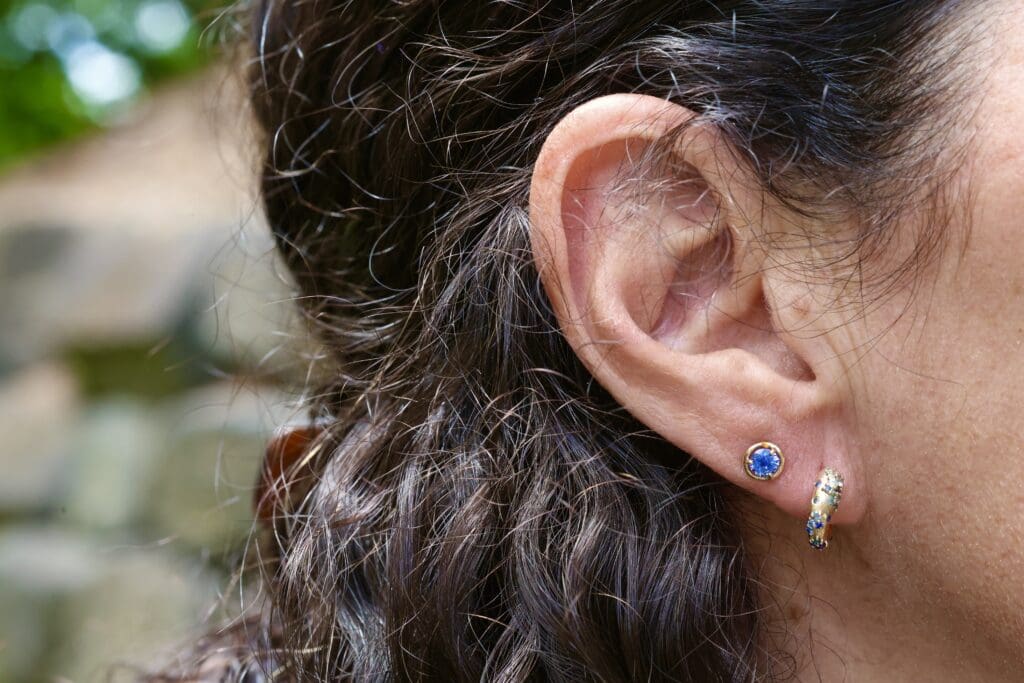
Our Wave Studs in Blue Sapphire by Dylann Wolfe. Photo by Chloe Beaumont.
These wave studs are a new design by designer Morgan Burger of Dylann Wolfe Jewelry. The second we saw them in person, we knew these would look amazing as second hole studs or by themselves–and boy were we right!
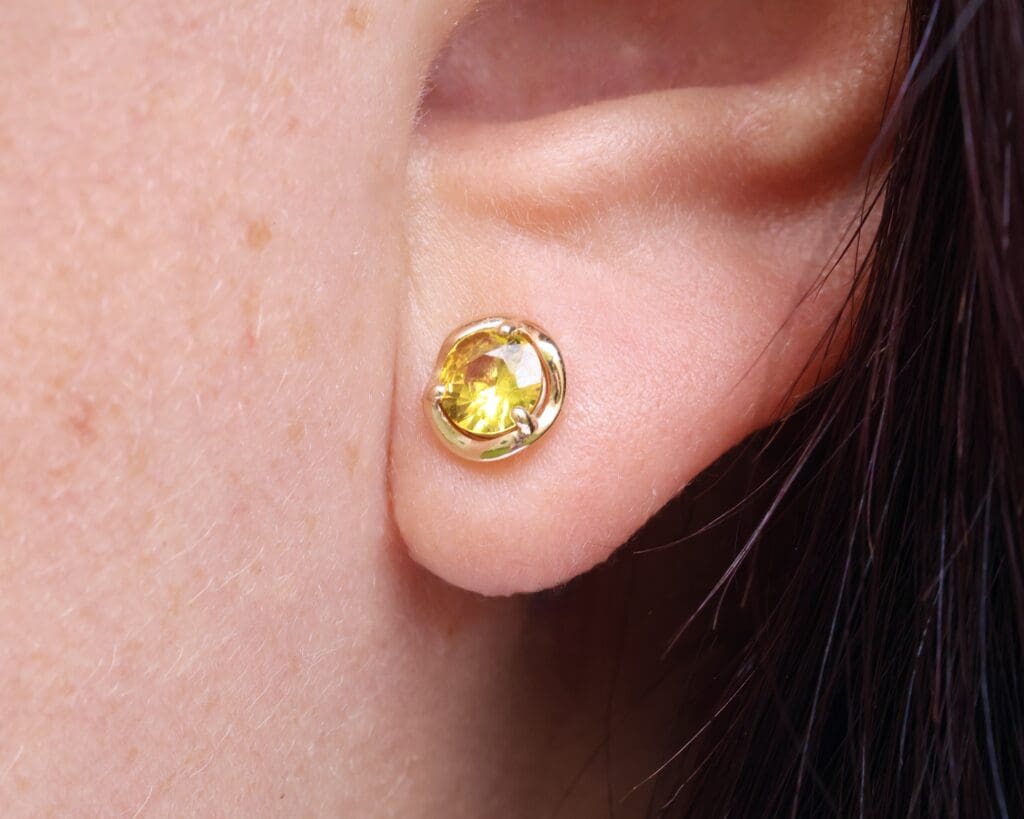
Our Wave Studs with 5mm yellow sapphires by Dylann Wolfe. Photo by Laura Beaumont.
These vibrant studs are the perfect pair of earrings for when you’re craving color but still want a more minimalist design.
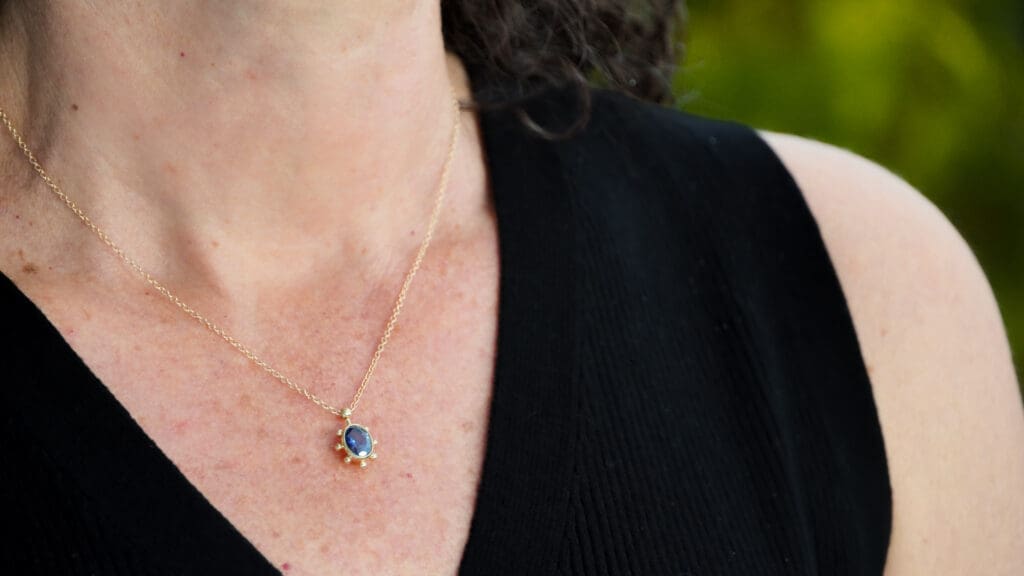
Our Elysia Necklace by M.Hisae in recycled 14kt yellow gold. Photo by Morgan Burger.
As for a necklace that you could wear everyday, we think our Elysia Necklace by M. Hisae is a great pick! Iolite is one of those gems whose violet hue seems to just fit right in with any other color palette. It’s deep, alluring, mysterious, and much more affordable than a sapphire would be in the same hue. This piece comes on a dainty 16 inch 14kt yellow gold cable chain that you’ll barely feel when wearing it.
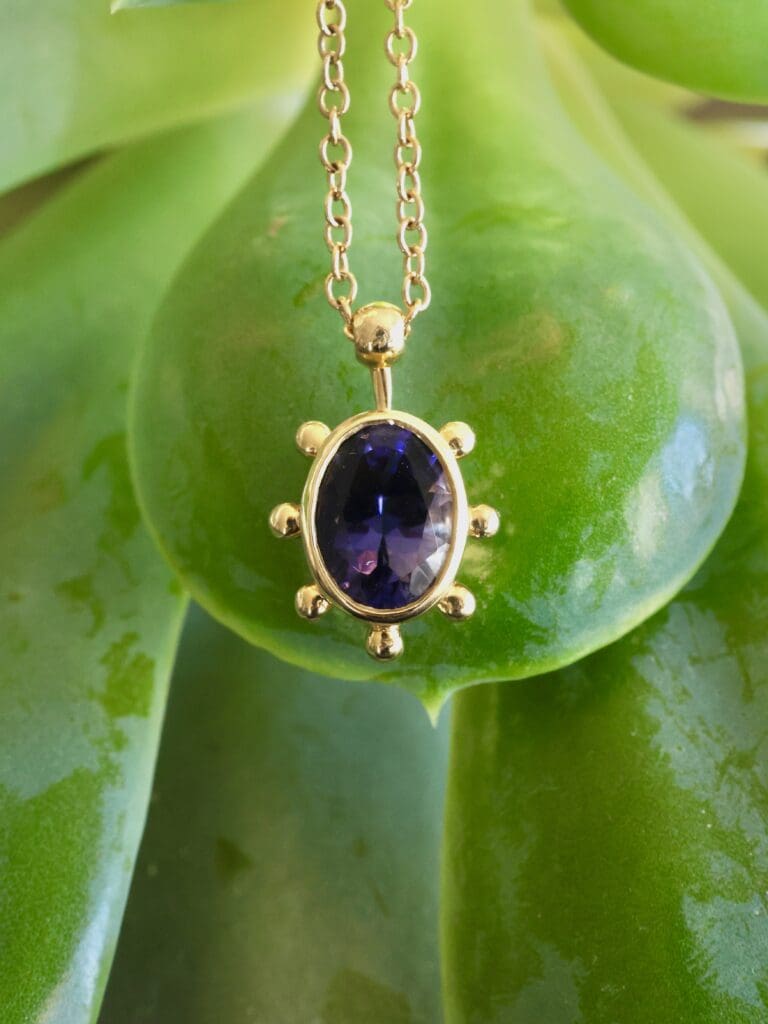
Our Elysia Necklace by M.Hisae. Photo by Chloe Beaumont.
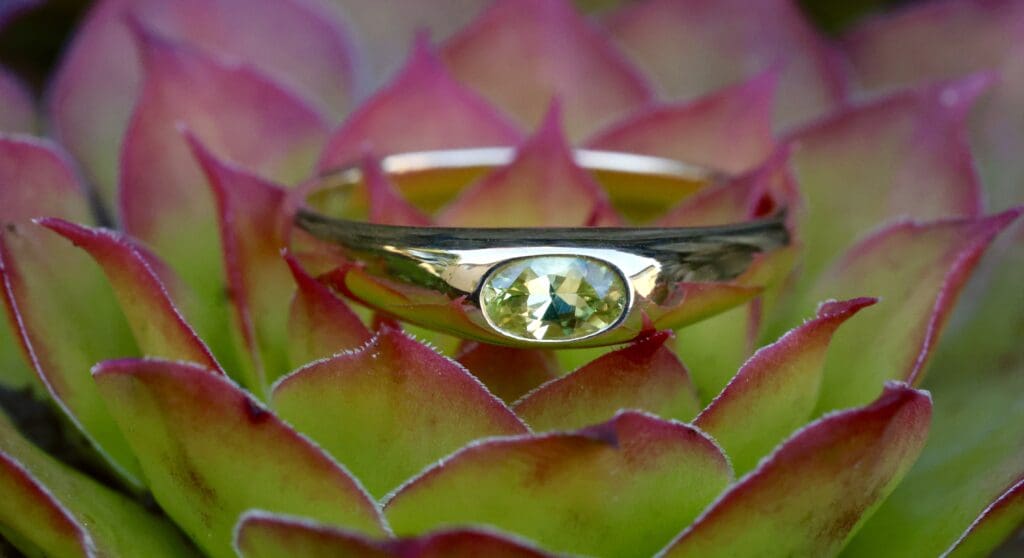
Our Petite Risa Ring in Yellow Sapphire by M. Hisae. Photo by Chloe Beaumont.
For our everyday ring pick, we’re going with another one of Michelle’s pieces: the Petite Risa ring. We love the version that features a gorgeous Australian yellow sapphire. It works to create an almost monotone (but never boring) vibe set in SCS-certified recycled 14kt yellow gold.
Plus, the sleek contour and comfort fit of this design makes the ring oh-so-comfortable when worn. It’s the dainty little pop of color your collection needs and be styled with just about anything.
Okay, so you have some staple pieces. Time to find a piece that really brings the “wow factor” and that will be a conversation starter no matter what room you walk into!
Chloe selected three pieces that we feel embody this exact vibe…
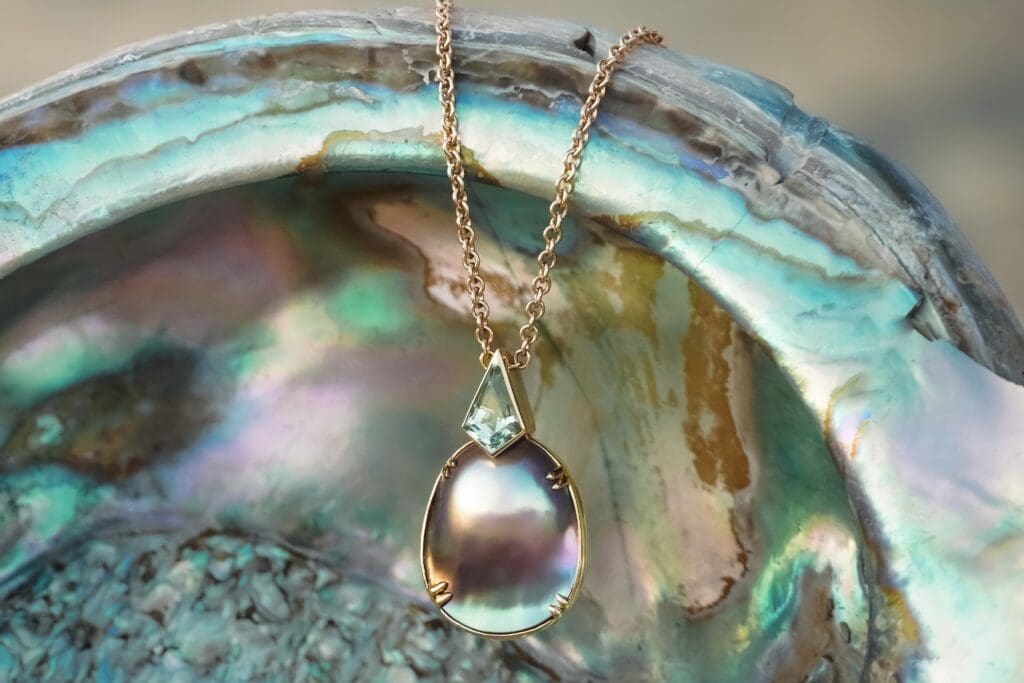
Our Sea of Cortez and Tourmaline Necklace by Dylann Wolfe. Photo by Morgan Burger.
The Sea of Cortez and Tourmaline Necklace by Dylann Wolfe is a little bit of a viral sensation. It’s gotten a LOT of love, but no one has claimed this one of a kind beauty (yet!)
The minty green tourmaline kite perched at the top doubles as the bail that the yellow gold chain slides through. The gorgeous luster of the pearl, flat + smooth gold setting on the back, and size of this piece all add up to visual impact that stops people in their tracks.
This statement piece needs no company, but if you wanted to pair it with something, we’d suggest a stack of Dylann Wolfe Long Lull eternity rings in seafoam green sapphire, blue sapphire, and lavender sapphire. For earrings, pair it with our Dylann Wolfe Wave Huggies in the Dawn Patrol colorway.
Another piece that we think is a great conversation starter is our Cortez Pearl and Diamond Swirl ring by Kathe Mai. (Can you tell we are obsessed with lavender pearls around here?!)
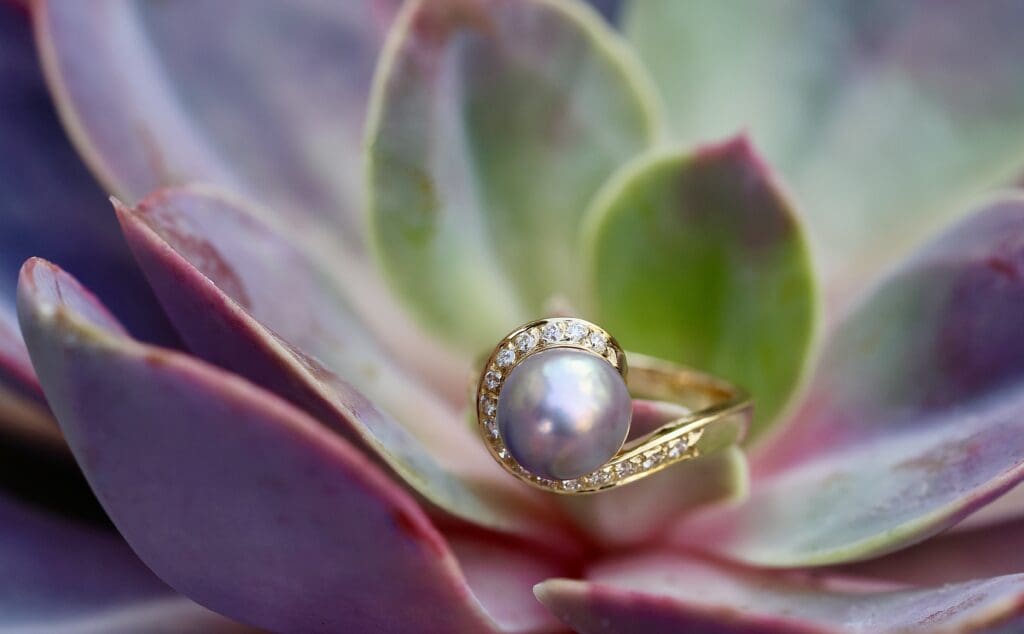
Our Cortez Pearl and Diamond Swirl ring by Kathe Mai. Photo by Chloe Beaumont.
This 18kt yellow gold stunner is magically captivating and has a higher finger profile to really stand out and catch your attention.
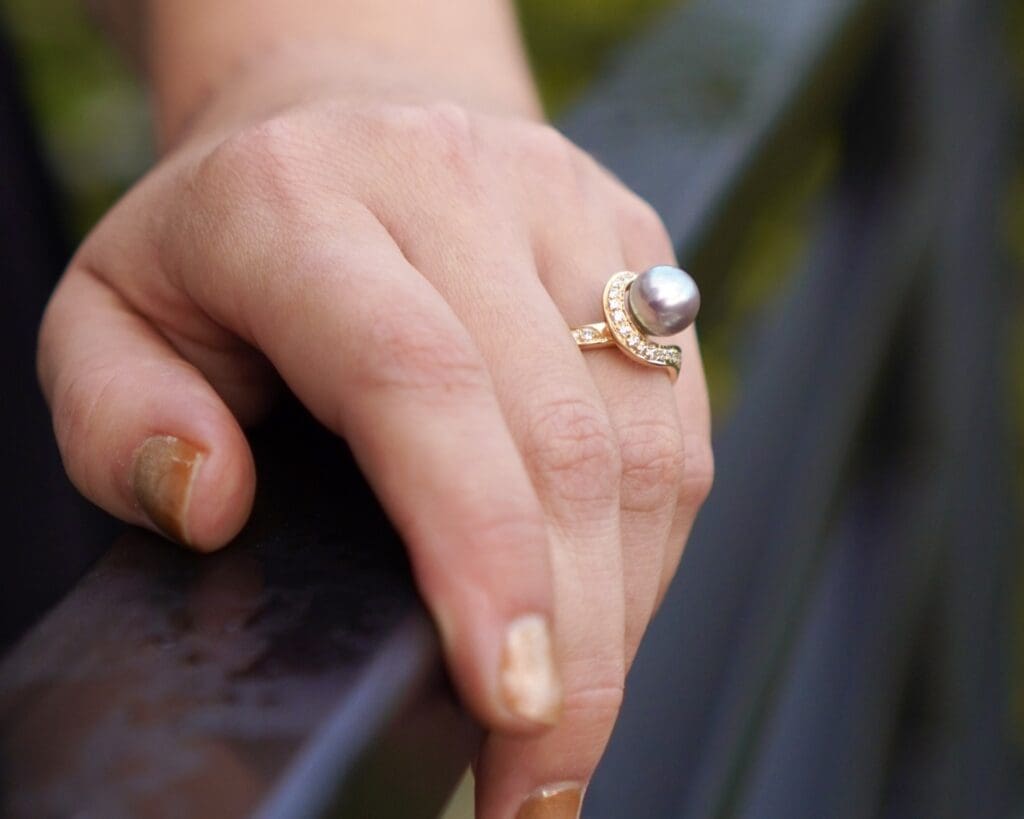
The Our Cortez Pearl and Diamond Swirl ring by Kathe Mai on model. Photo by Morgan Burger.
The way the diamonds swirl around the Cortez pearl is unique and whimsical, and helps to add to the organic nature of the piece.
Did you know that Cortez pearls are the rarest of cultured pearls? Only 4,000 are cultivated per year, maximum. Another great point to bring up when people compliment you on your Cortez pearl piece!
Finally, our third “conversation starter” pick is our Dumortierite and Tanzanite Cauldron Pendant by Mercurius Jewelry.
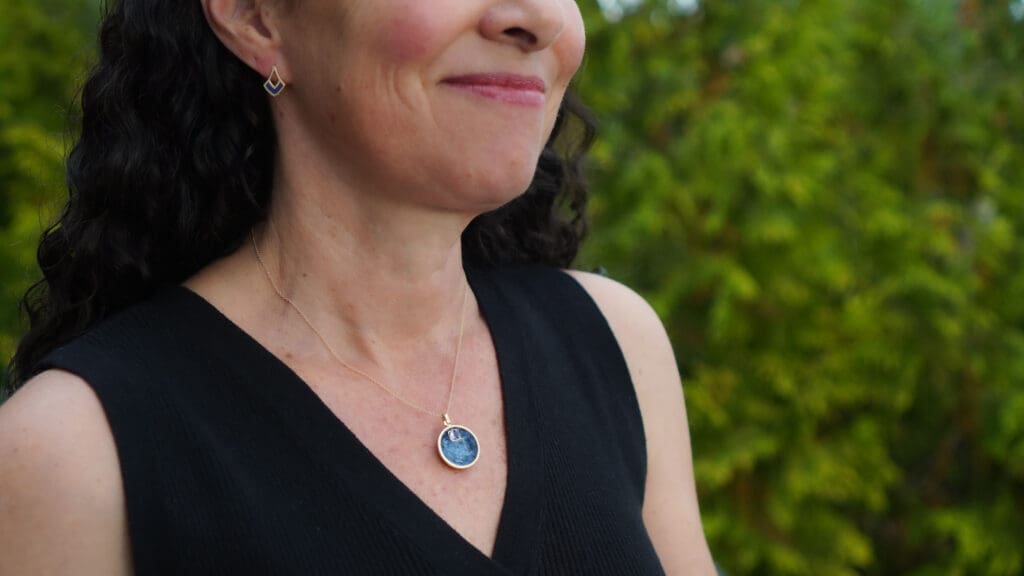
Our Dumortierite and Tanzanite Cauldron Pendant by Mercurius Jewelry. Shown here on our 18 inch Photo by Morgan Burger.
This one-of-a-kind piece was handcrafted by David Thorp, the husband of the husband-wife duo that is Mercurius. David is exceptionally talented at the bench, and believe it or not he hand-carved the dumortierite into a cauldron shape by hand, as well as delicately set it and the tanzanite that appears to float above it.
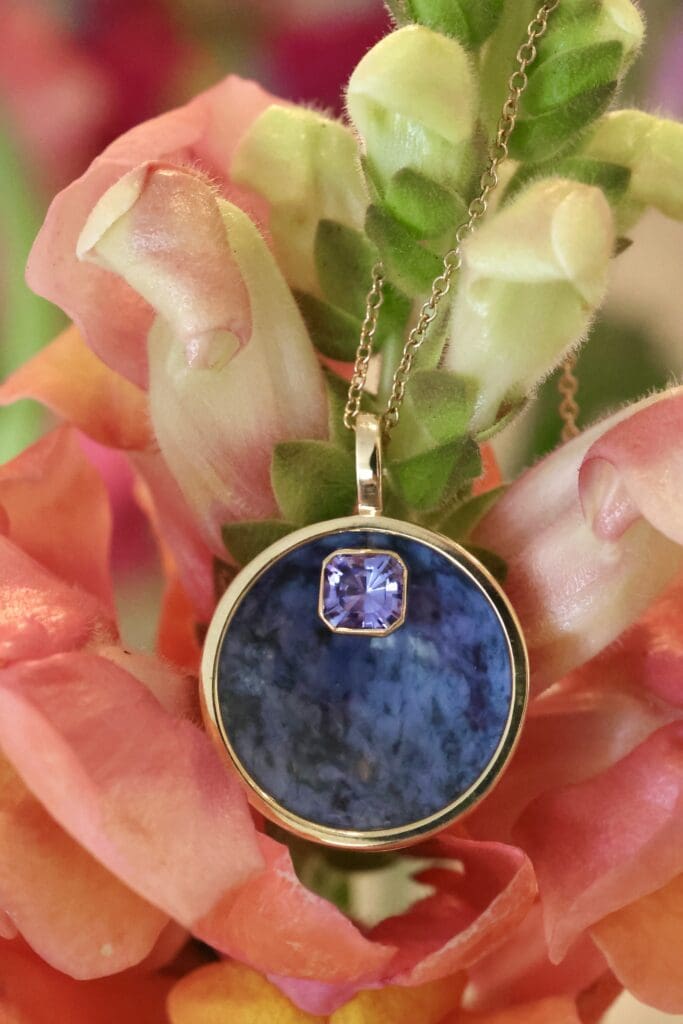
Our Dumortierite and Tanzanite Cauldron Pendant by Mercurius Jewelry. Shown here on our 16 inch 14kt Fairmined yellow gold cable chain.
We sell this unique pendant separately from any chain, so you can pair it with a chain you already own or choose one from our collection. We think it pairs best with a dainty chain so the cauldron becomes the centerpiece and focus.
The purple and blue color palette compliments many outfits, and creates a piece that is modern with a “cool girl” twist.
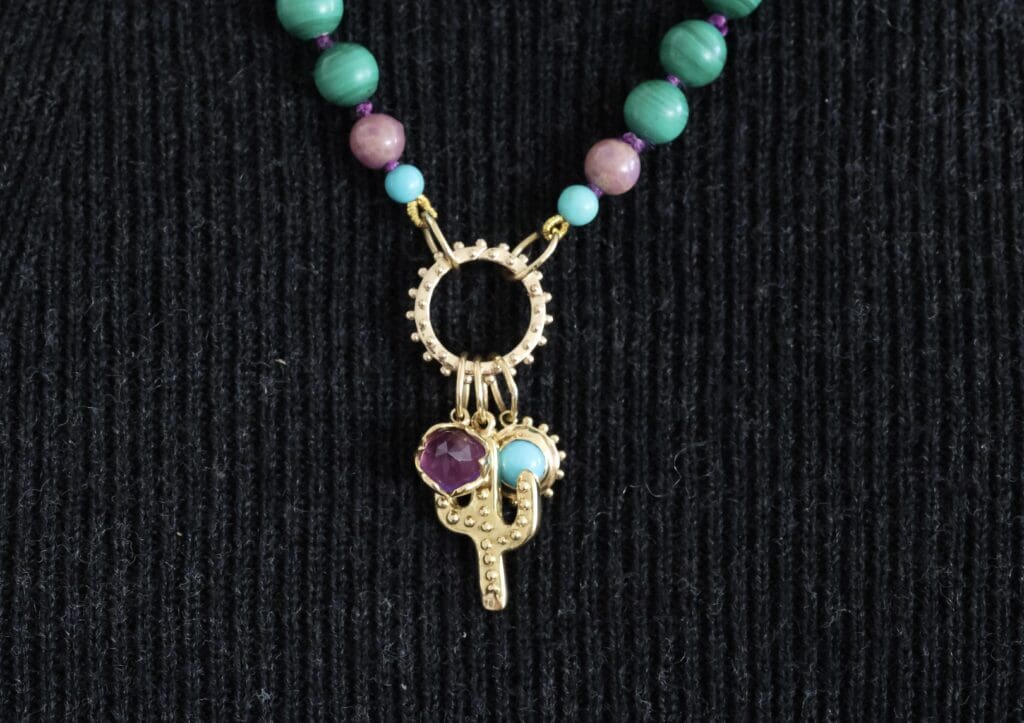
Our Amethyst Lotus, Turquoise Soleil, Cactus Pink Sapphire Charm, Plain Clicker, and Boheme Provence Open Ended Strand by Delphine Leymarie. Photo by Chloe Beaumont.
There’s nothing more fun and customizable than creating your own “charm jumble” aka collection of charms you can style together! Our Delphine Leymarie Charms easily slide onto an open “clicker” connector, which then connects to any of our open-ended bead or metal chain strands.
There are endless possibilities when it comes to charms, and we love the ability to start with one and then collect multiple that you can mix and match depending on your mood or outfit.
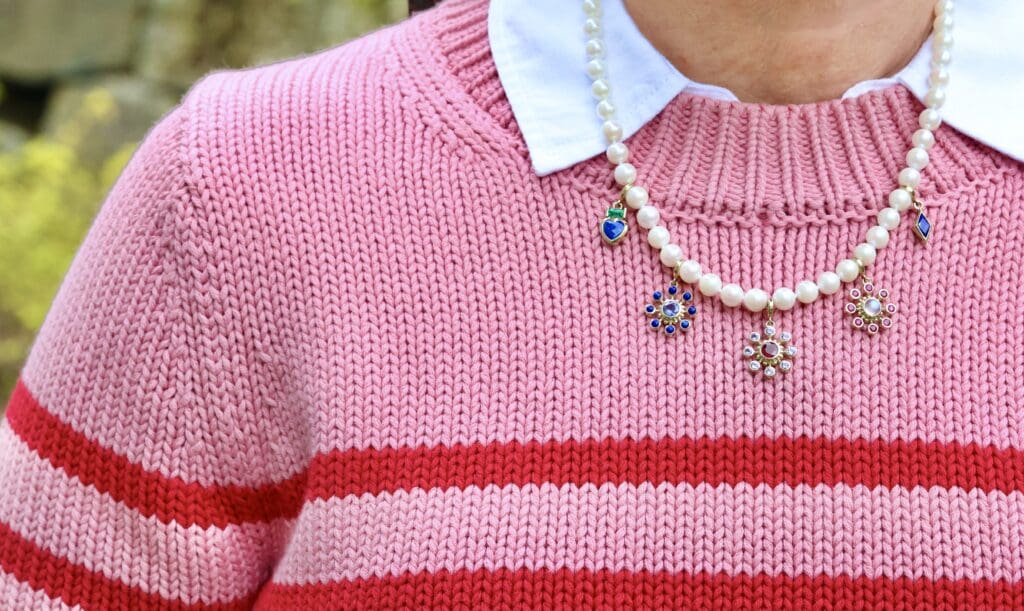
The Akoya Pearl Strand with the Tillya Tepe Heart Charm, Lapis and Sapphire Cosmos Charm, Tanzanite and Ruby Cosmos Charm, Ruby and Moonstone Cosmos Charm, and Zan Charm in Lapis Lazuli. Photo by Chloe Beaumont.
Plus, charms make great gifts if you are shopping for a loved one! The lucky recipient can easily slip them onto their favorite chain or pick out what they’d like to pair it with from our collection. It’s less pressure than buying them a whole necklace when you’re not sure what length or style chain they’d want.
If you’re building your own collection, charms are just the most fun way to add interest to a strand of pearls, (our Mazahri charms have a bail that opens and snaps over pearl knots!) or a piece that would be great for layering.
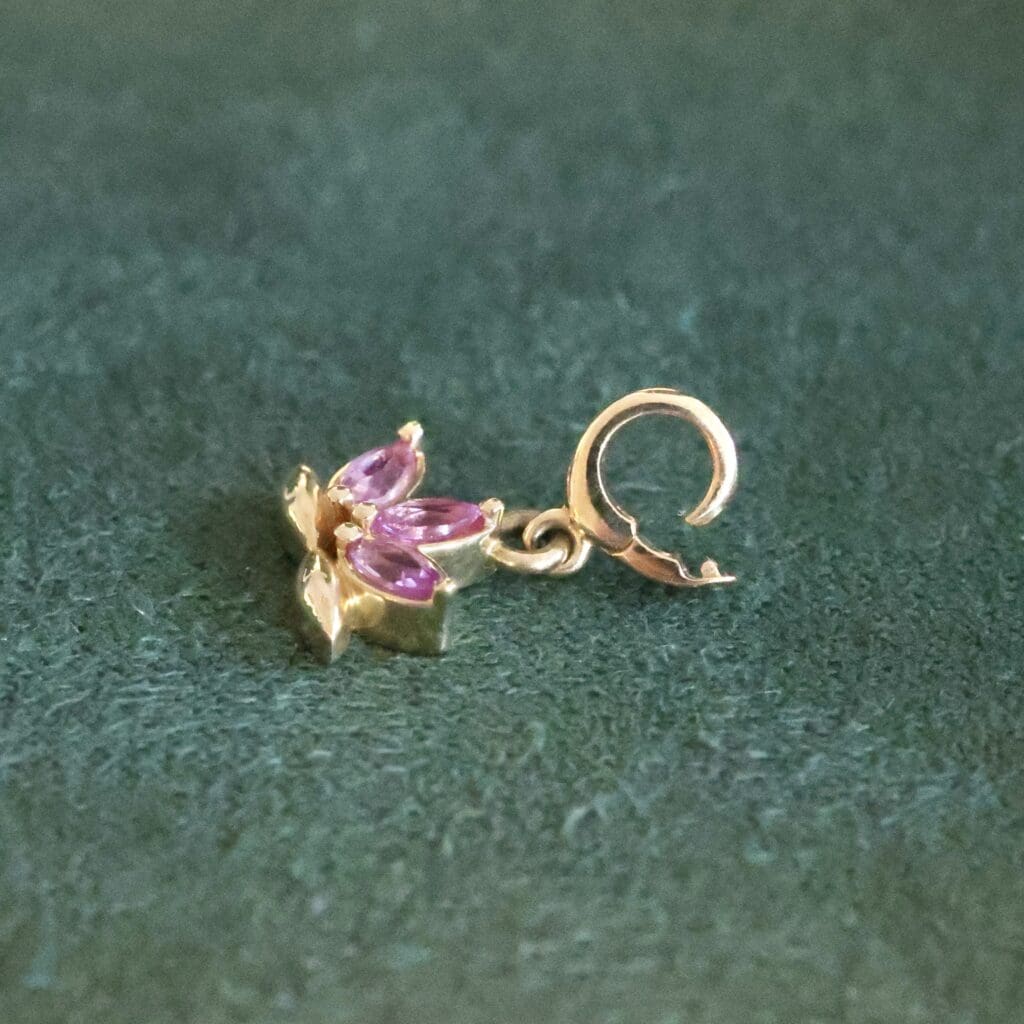
Our Lotus Charm by Mazahri, with the bail open to show how it works. Photo by Chloe Beaumont.
We’ve intentionally curated a collection of charms that can be styled so many different ways, while still giving your look little pops of color. The serpent charm below features a raspberry colored rhodolite garnet from Tanzania. We actually know this gem was mined by a woman and is a traceable “Moyo Gem” sourced from gem supplier ANZA Gems.
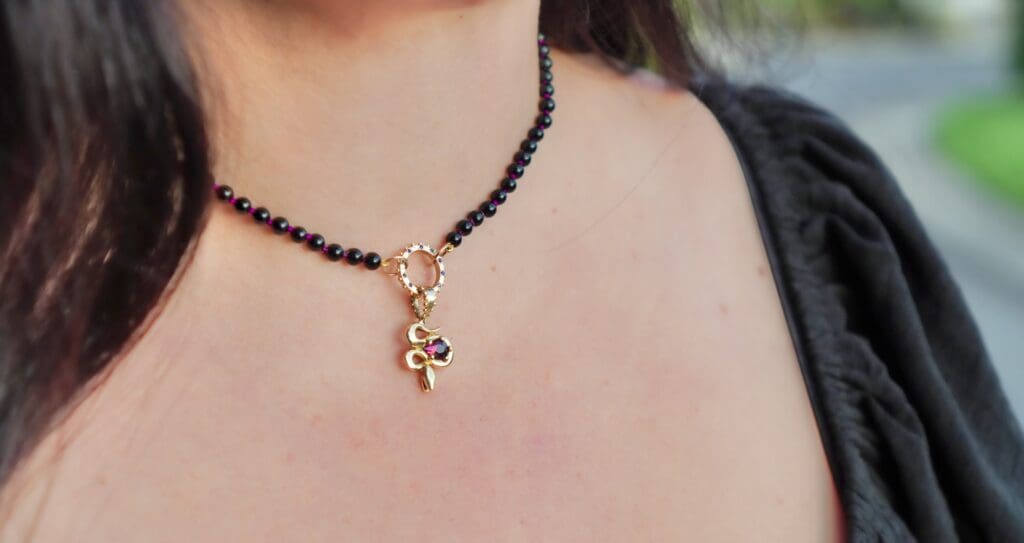
Our Garnet Serpent Charm, Blue Sapphire Clicker, and Onyx Open Ended Bead Strand by Delphine Leymarie. Photo by Morgan Burger.
Each “Moyo Gem” donates a percentage of its sale towards uplifting women miners and their communities in East Africa. So, it’s only natural that designers like Delphine as well as ourselves love to work with these gems!
We truly hope this blog was helpful as you go about building your colored gemstone jewelry collection this year!
Stay sparkling,
~Laura + Chloe Beaumont
We think charms are one of the most giftable jewelry pieces and make for the perfect first gift guide edit!
When you give someone a charm, you don’t have to worry about what size they are, or if they will like how a piece fits into their ear stack. So many of our charms can be worn over a variety of chain thicknesses or have bails that open too, so you don’t have to fret about what chains to pair them with!
Plus, charms are super meaningful and collectable: most people cherish charms because of the memories or people attached to them. Each one tells a story and is a sweet little way to show someone you know and love them.
There are so many ways you can approach charm gifting: by that person’s birthstone, their favorite color, or a symbol that means something to them or reminds you of them (or if the stars align, multiple of these at once!!)
Here are some of our favorite, most giftable charms we’ve curated from our designers, starting from lowest price point to highest….
#1. The Fiona Flower Charm
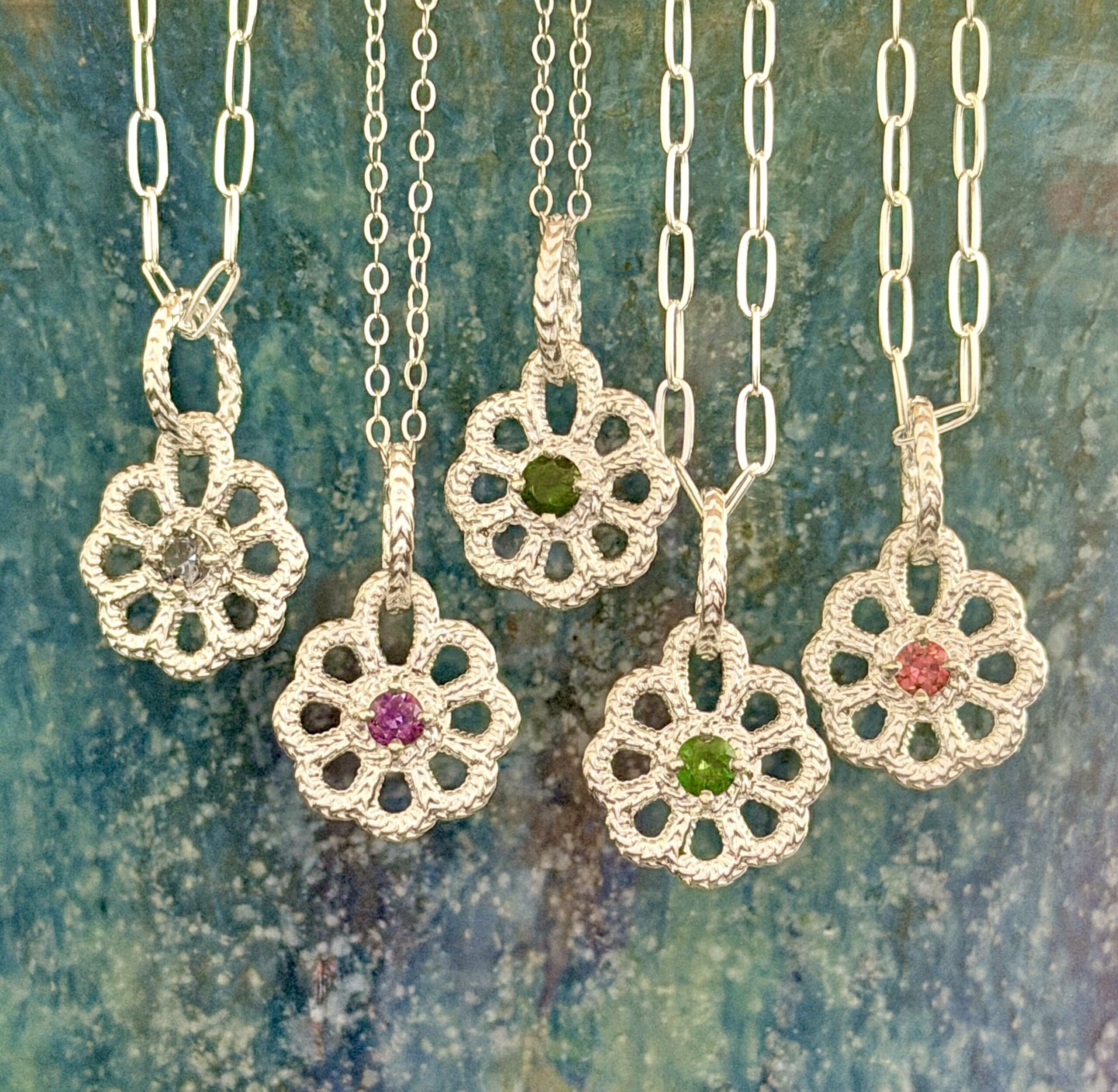
One of the newest charms we’ve added to our online collection of phenomenal Twyla Dill pieces just happens to also be one of the most affordable, at under $600 each.
These Fiona flower charms come in five different natural gemstones (pink sapphire, blue sapphire, orange sapphire, green garnet, and green tourmaline) and are so easy for flower lovers to style.
Their bail is large enough to fit over both dainty chains like the paperclip and cable ones shown in the photo above, or over Twyla’s Taylor chain necklace! (We were very happy to make this discovery!)
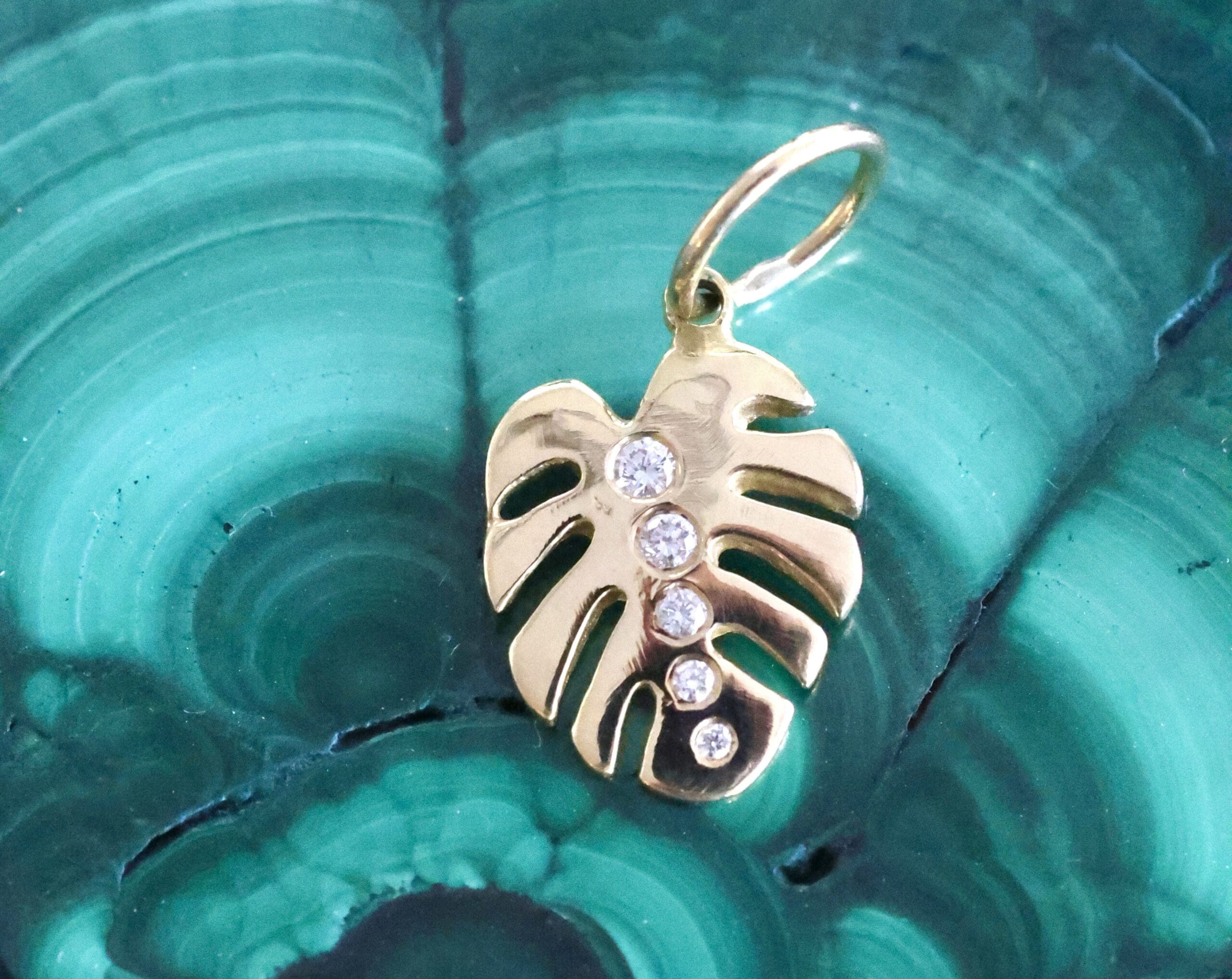
#2. The Diamond Monstera Charm
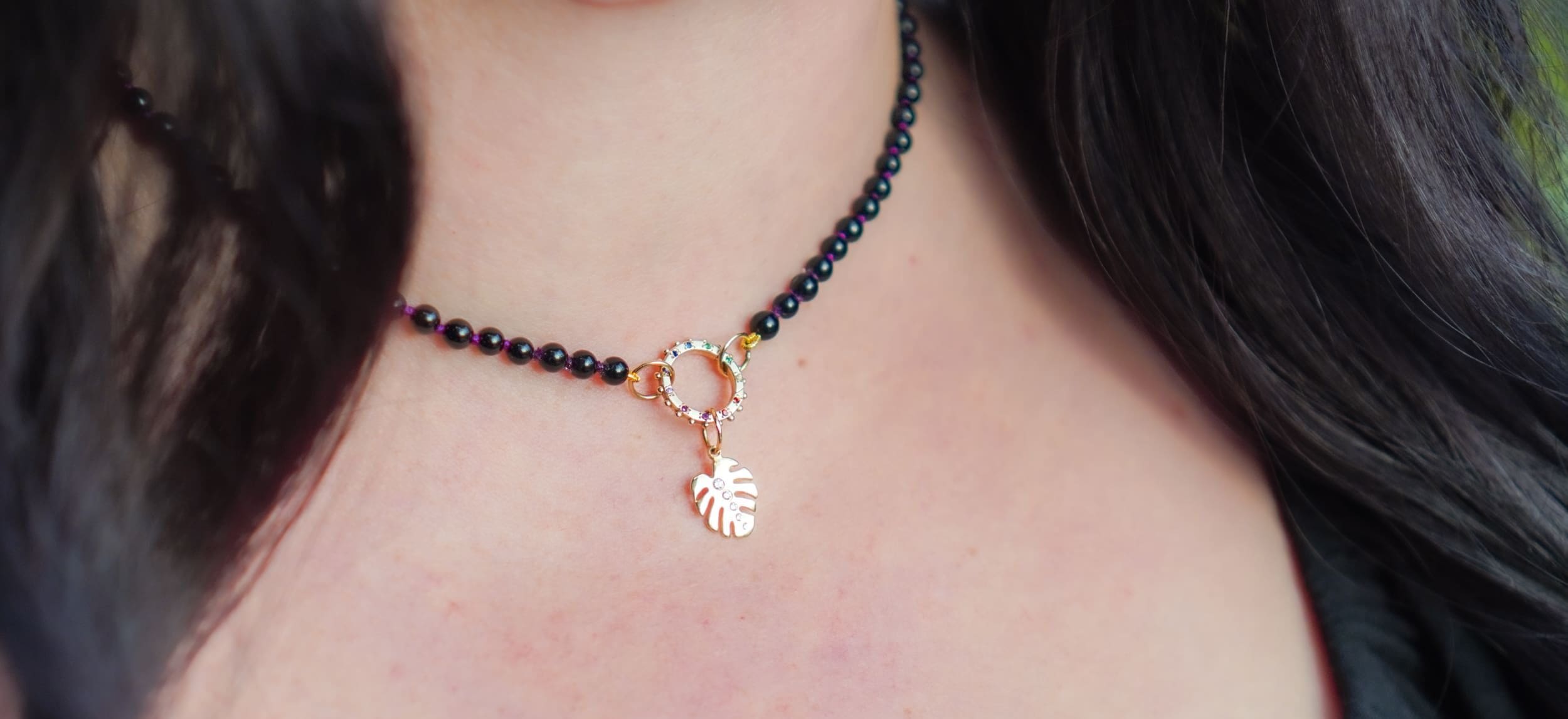
Do you have a plant lover in your life? Or someone with a green thumb? This charm would be perfect for them! It’s a super cute little monstera leaf in 18kt recycled yellow gold, adorned with five little diamonds to give it extra sparkle.
Like all Delphine Leymarie charms, it is designed to be paired with Delphine’s “clicker” connectors (that open and click closed, hence the name) but you could also gift just the charm and let the recipient sling it over a chain of their choice.
#3. The Mini Acorn Charm
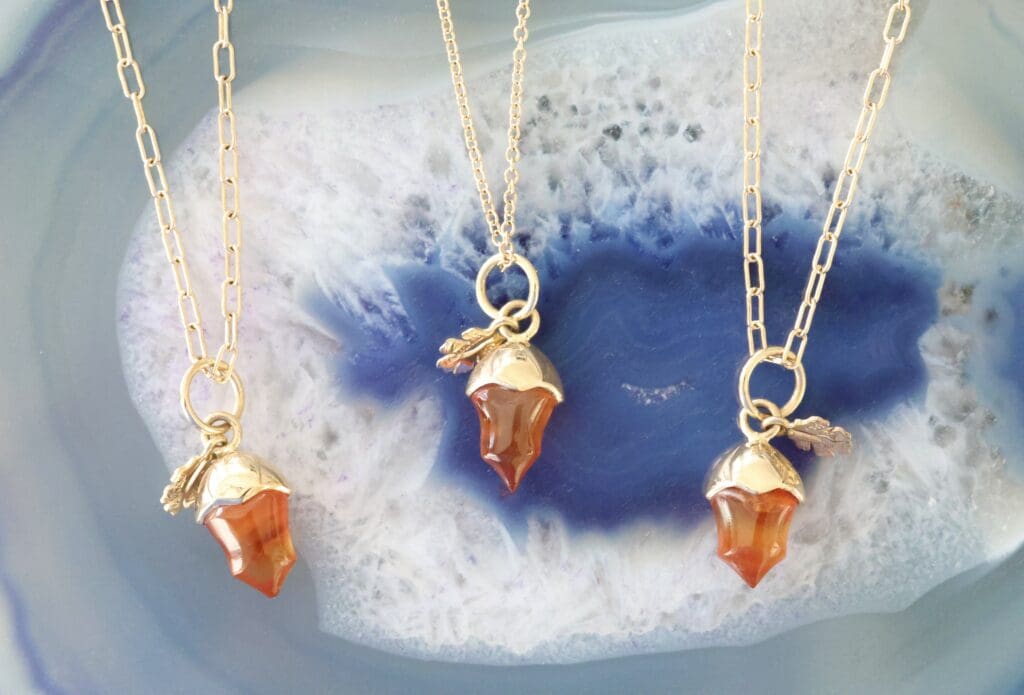
Autumn is officially here, and our Mini Acorn charms would make the perfect addition to someone’s fall-themed charm jumble!
Each one was hand-carved out of Carnelian and set in 14kt Fairmined yellow gold by David Thorp of Mercurius Jewelry. David + Alisa even decided to add a little oak leaf dangle, which we think is the cutest little detail that makes these charms extra special.
We only have three, and they are exclusive to our online store!
#4. The Zan Charm
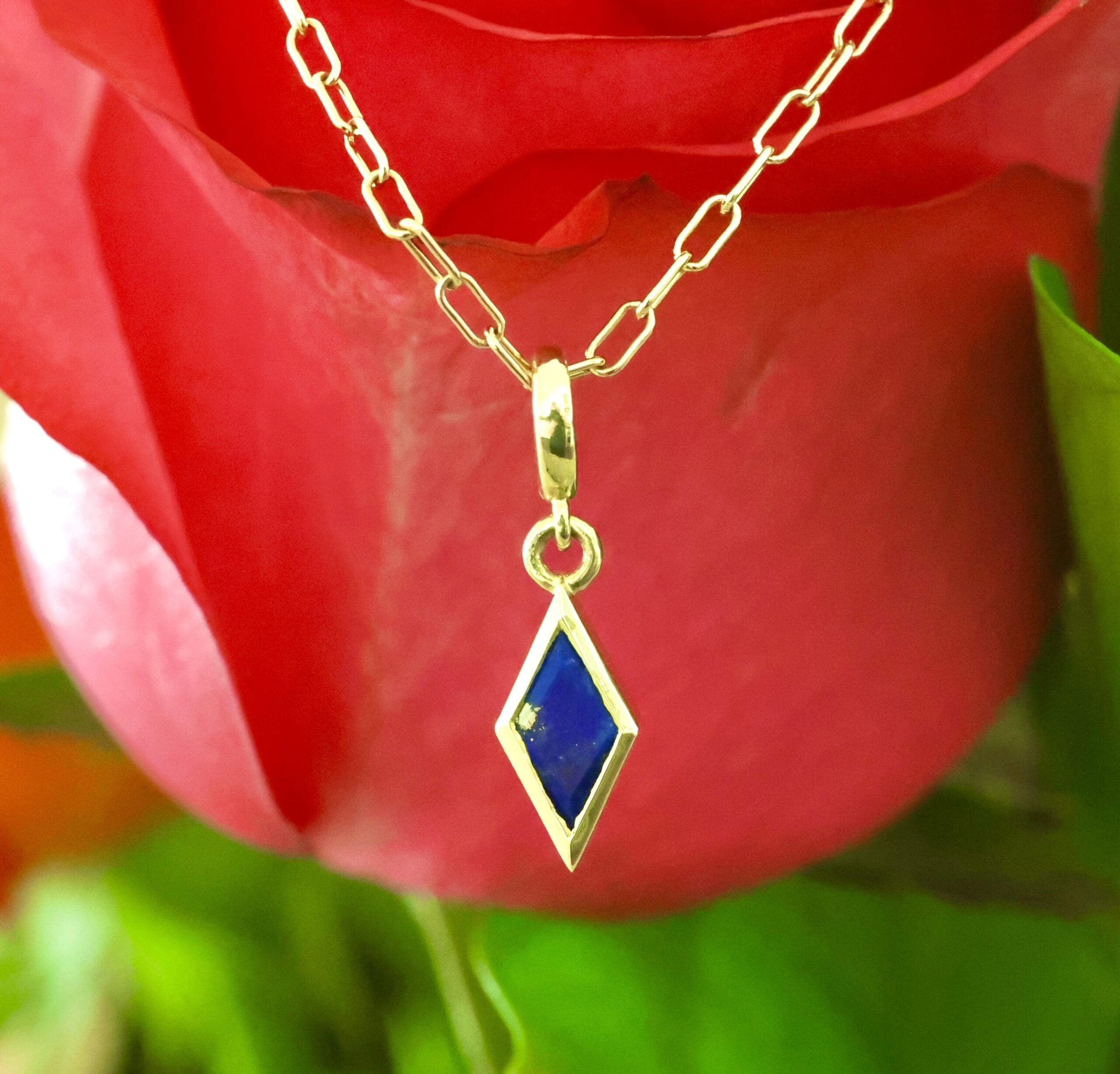
If you are looking to give a symbol of women’s empowerment, look no further than the Zan charm! “Zan” actually means woman in Farsi, one of the languages spoken in Afghanistan where the designer Zulaikha is originally from.
Zulaikha's Zan pieces celebrate women in all their forms and represent her deep commitment to women's rights (she is also a human rights lawyer!)
This charm now comes in both lapis lazuli and turquoise, two hues of blue that seem to pair well with everything.
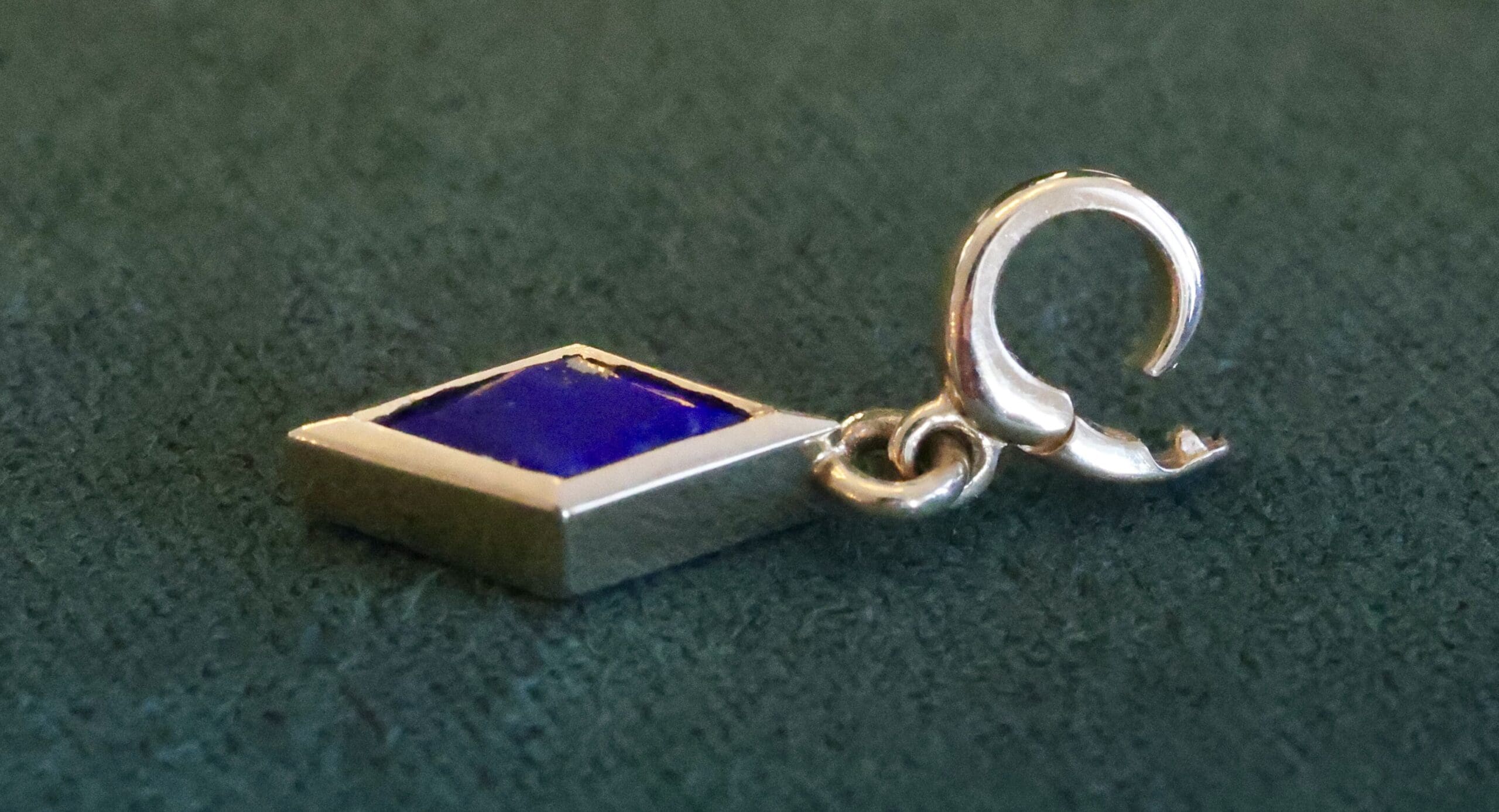
Just like all our Mazahri charms, the Zan charm has a bail that opens and snaps closed, so it can be hooked onto connectors, chain links, clasps, or slid onto chains.
The styling possibilities are endless!
#5. The Lotus Flower Charm
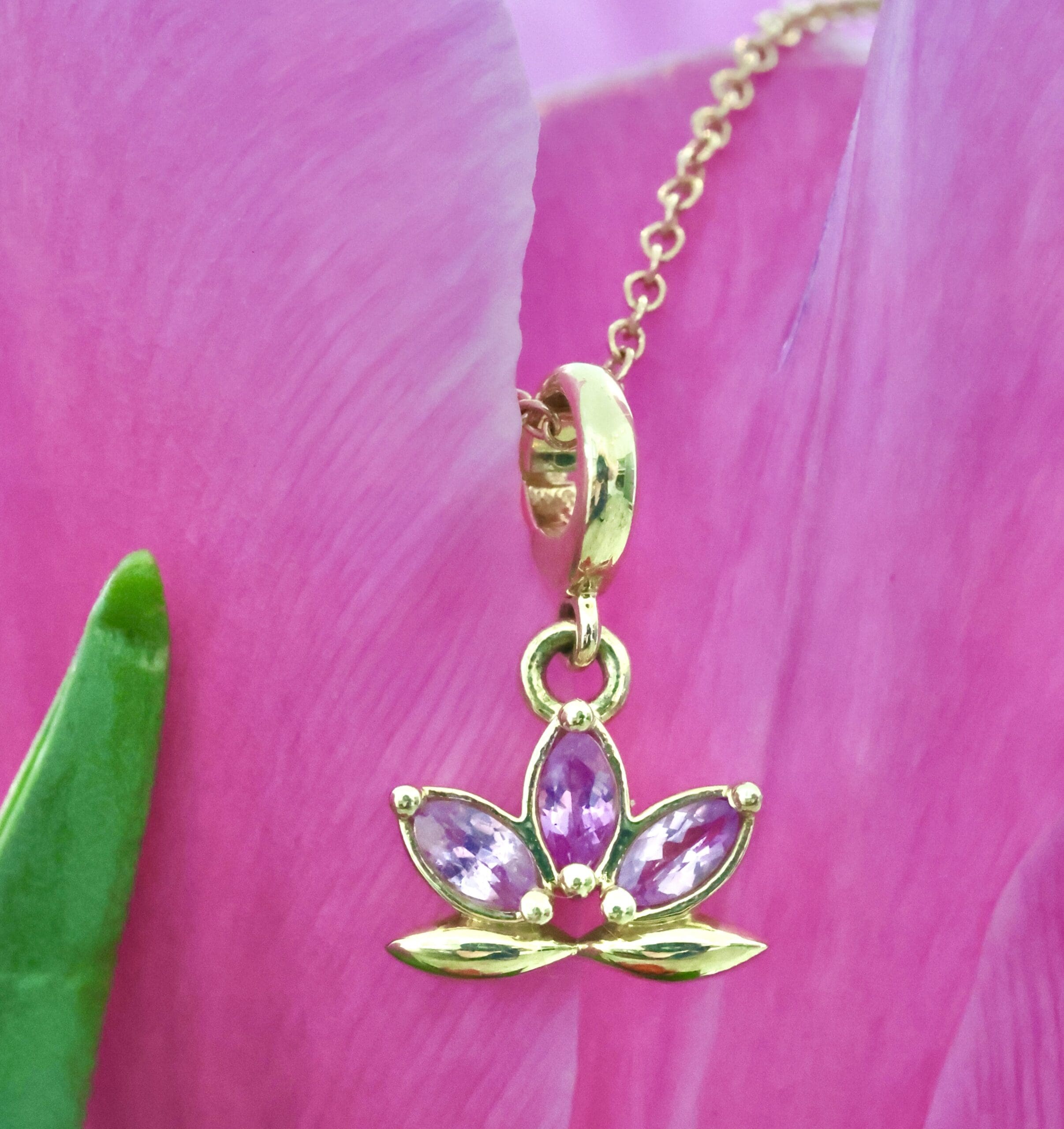
Another Mazahri charm we love is the Lotus Flower charm. Our version has three pink Sri Lankan sapphires, perfect for both pink and flower lovers.
The lotus flower is a powerful symbol of peace, enlightenment, rebirth, and spiritual growth.
Gifting this charm would be a wonderful way to acknowledge that you see the core of who they are and are proud of all the growth they’ve achieved.
#6. The Sunburst Charm
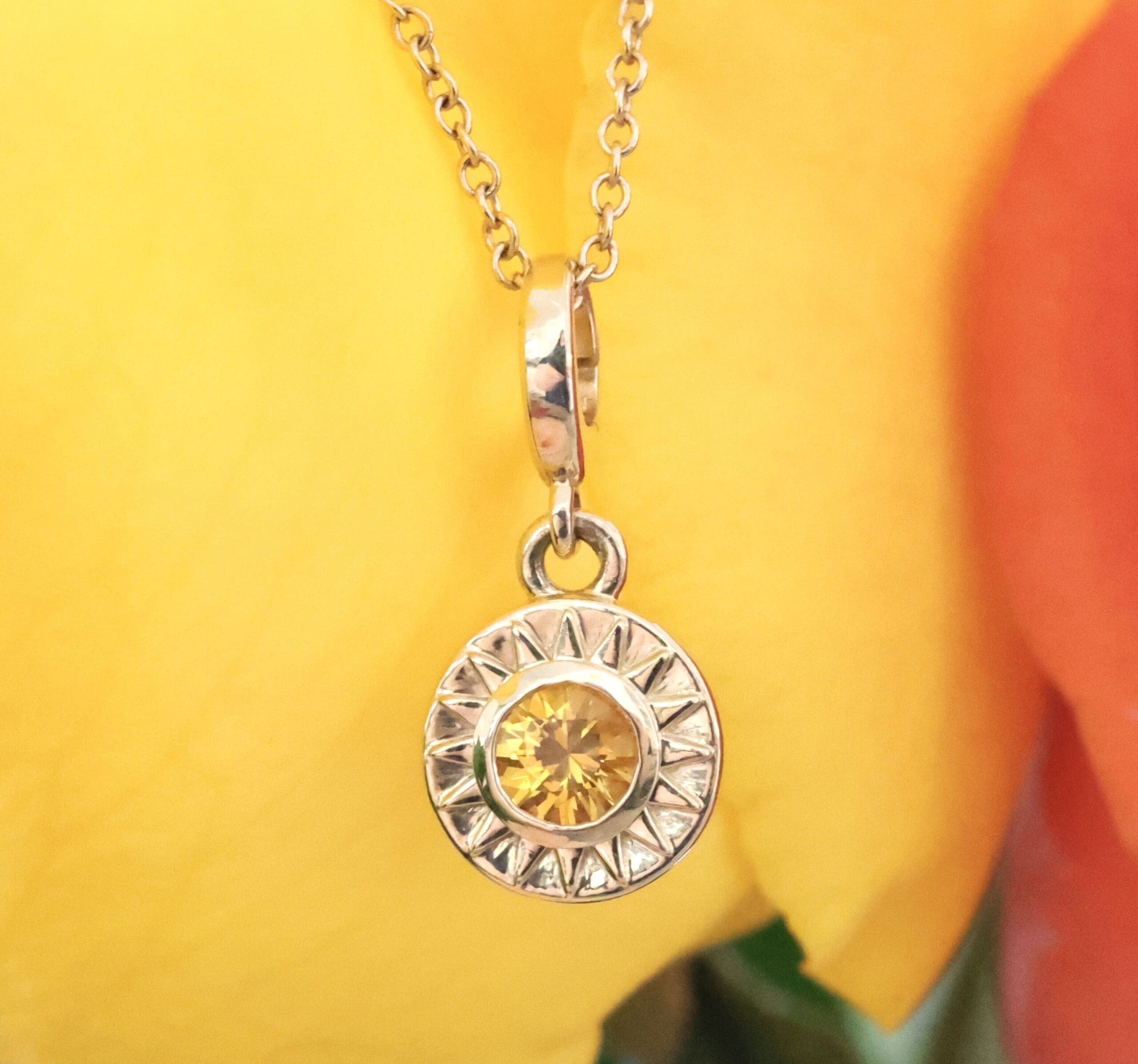
Who doesn’t need some extra sunshine in their life?!
We certainly do, especially during the darker winter months.
This Mazahri Sunburst charm would be a warm, cheery addition to someone’s charm collection. There’s just something about yellow sapphire that never fails to spark joy.
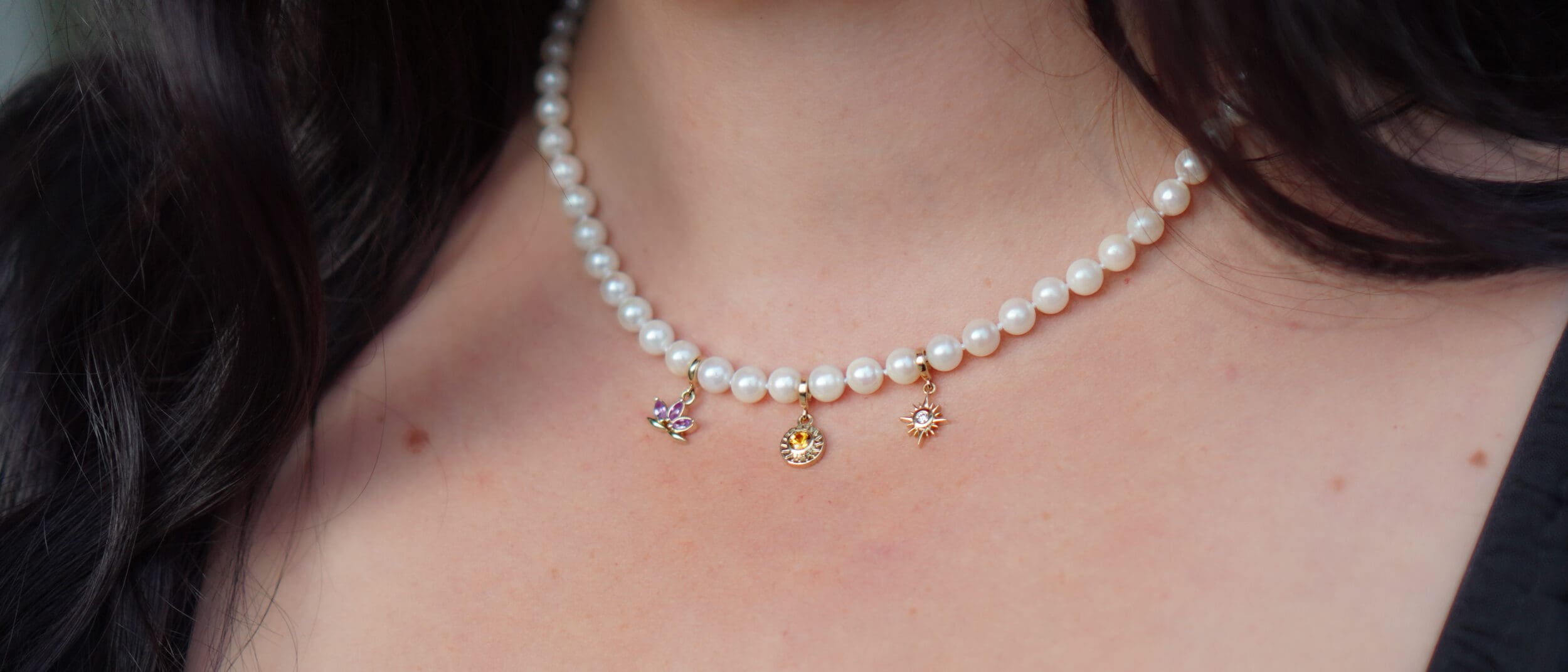
In love with our Mazahri charms, or can’t decide which one to get? Consider getting multiple: it allows you or your loved one to swap, charm stack, and style them in so many more ways!
We snapped three charms onto our Akoya Pearl strand and absolutely love this look.
#7. The Boheme Flower Charm
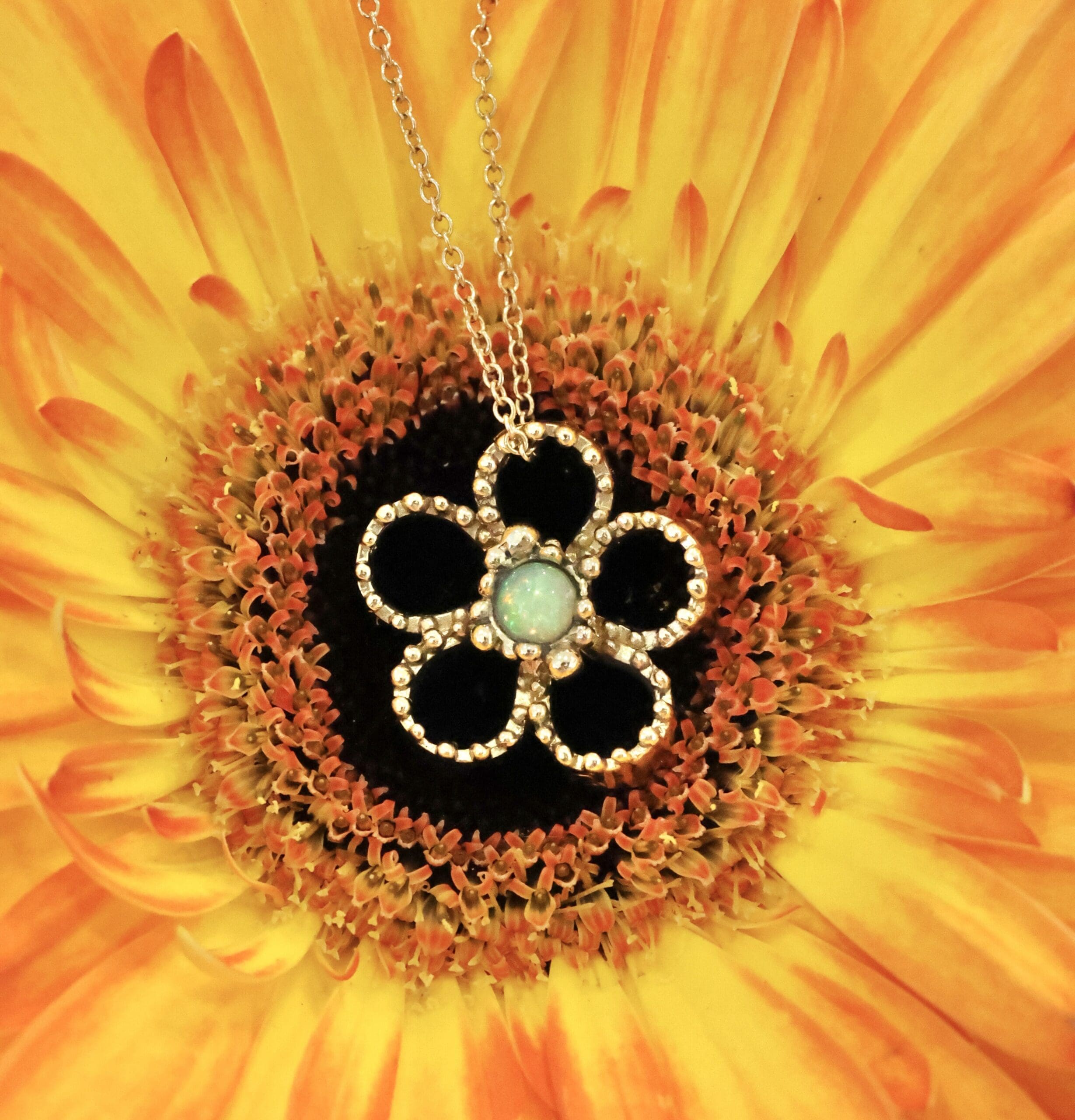
A different take on a flower charm as you’ve ever seen! This Delphine Leymarie charm is an exclusive she created just for us, so whoever you get one for won’t see it anywhere else.
It’s unique in that each one of the petals can function as a bail. Just pick a petal, sling it onto a chain, et voila!
Whether you go with rose, white, or yellow gold, each one features an Ethiopian opal cabochon in the center. If you know or love an October baby, this would be perfect for them since Opal is one of October’s birthstones!
#8. The Cosmos Charm in Tanzanite + Ruby
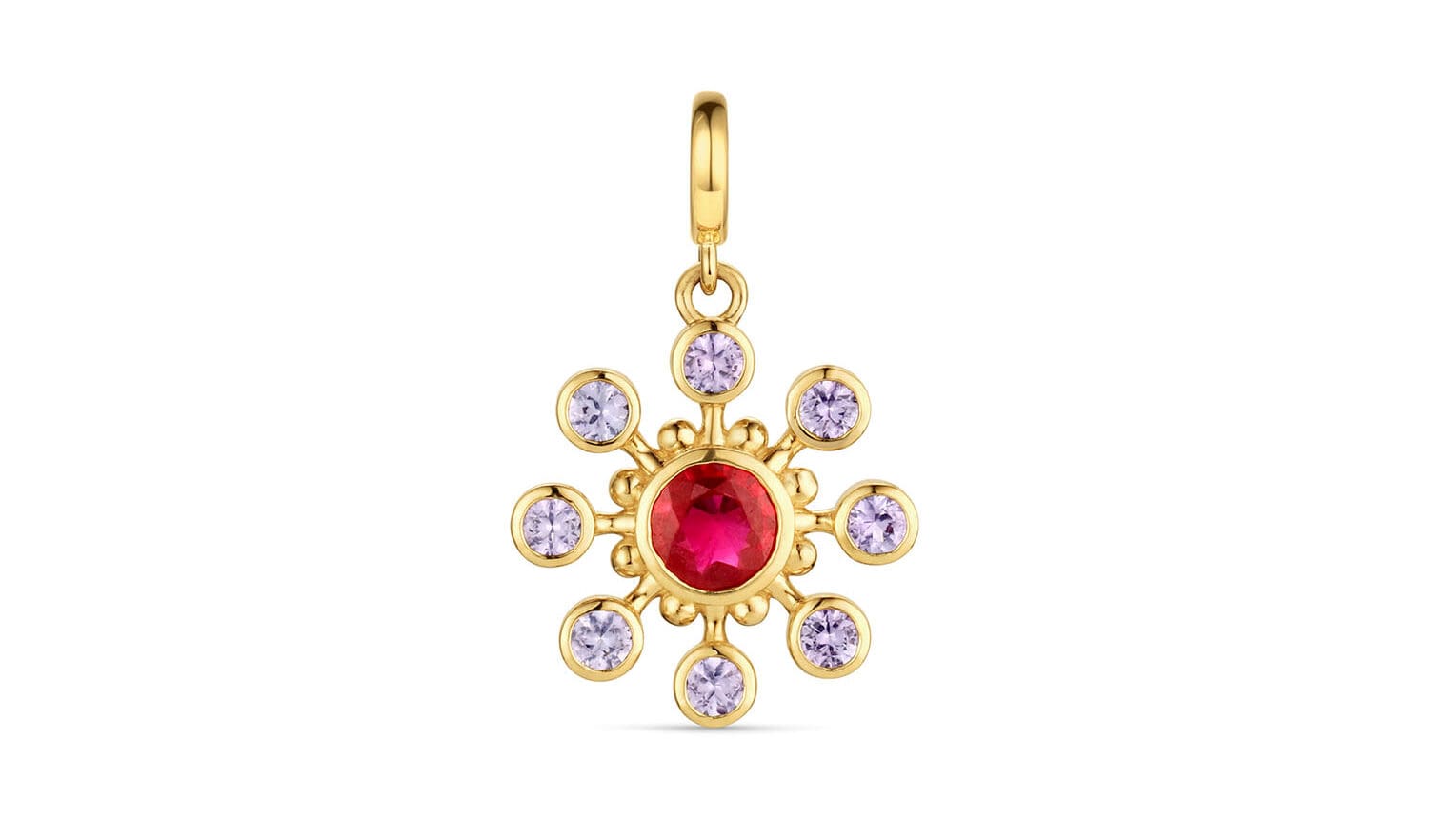
One of our newest charm additions from Mazahri is this spectacular Cosmos Charm (pictured above in Tanzanite and Ruby!)
You could gift this charm to someone who loves flowers, has Ruby as their birthstone, or is simply a fan of fun color combos!
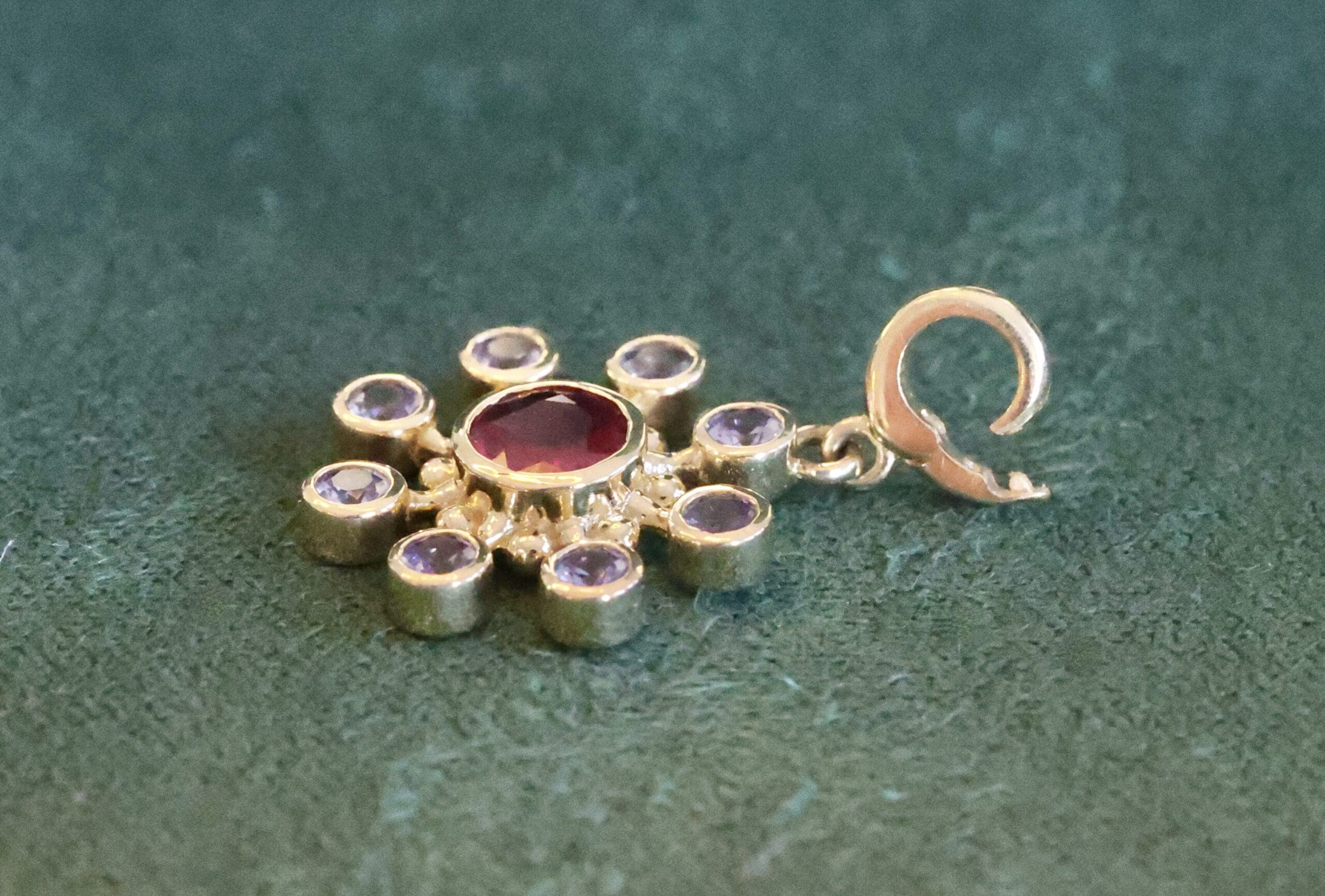
Like all Mazahri charms, it has the ability to snap over pearls, beads, or a chain.
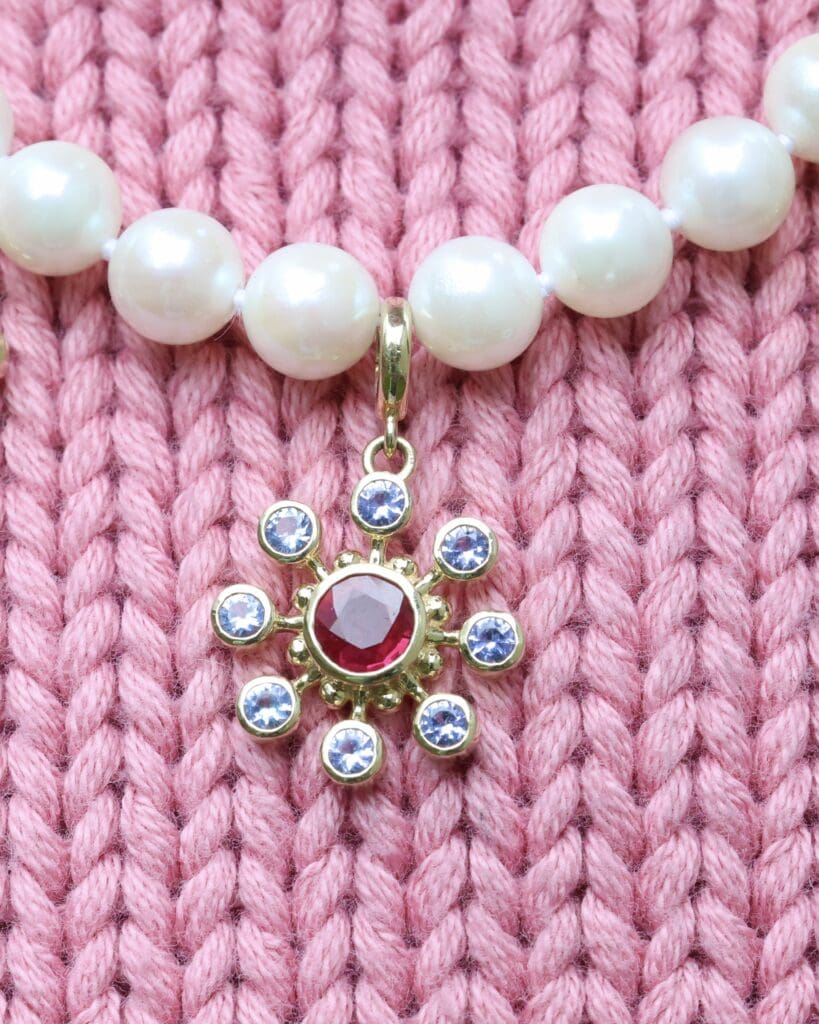
One of the best things about charms is their versatility, and this charm design really keeps that theme going!
To us, flowers aren’t just for spring, and the vibrant ruby and tanzanite gems that Zulaikha paired together ensure that this isn’t just another “pastel flower girl” vibe.
The Cosmos design actually has a really deep meaning; the center ruby represents our creator, and the eight accent tanzanites represent us coming together in community. The tiny gold spheres represent us as individuals - all connected to each other and emanating from one.
How beautiful is that?
We hope you found this charm guide useful, whether you are picking something out for someone special, or looking to add a charm to your own collection!
If you see something that you are falling in love with but would like more videos sent to you, or have any questions, feel free to reach out to us via email info@beaumontjewelrycollective.com or DM us on instagram!
Keep sparkling,
~Laura and Chloe Beaumont
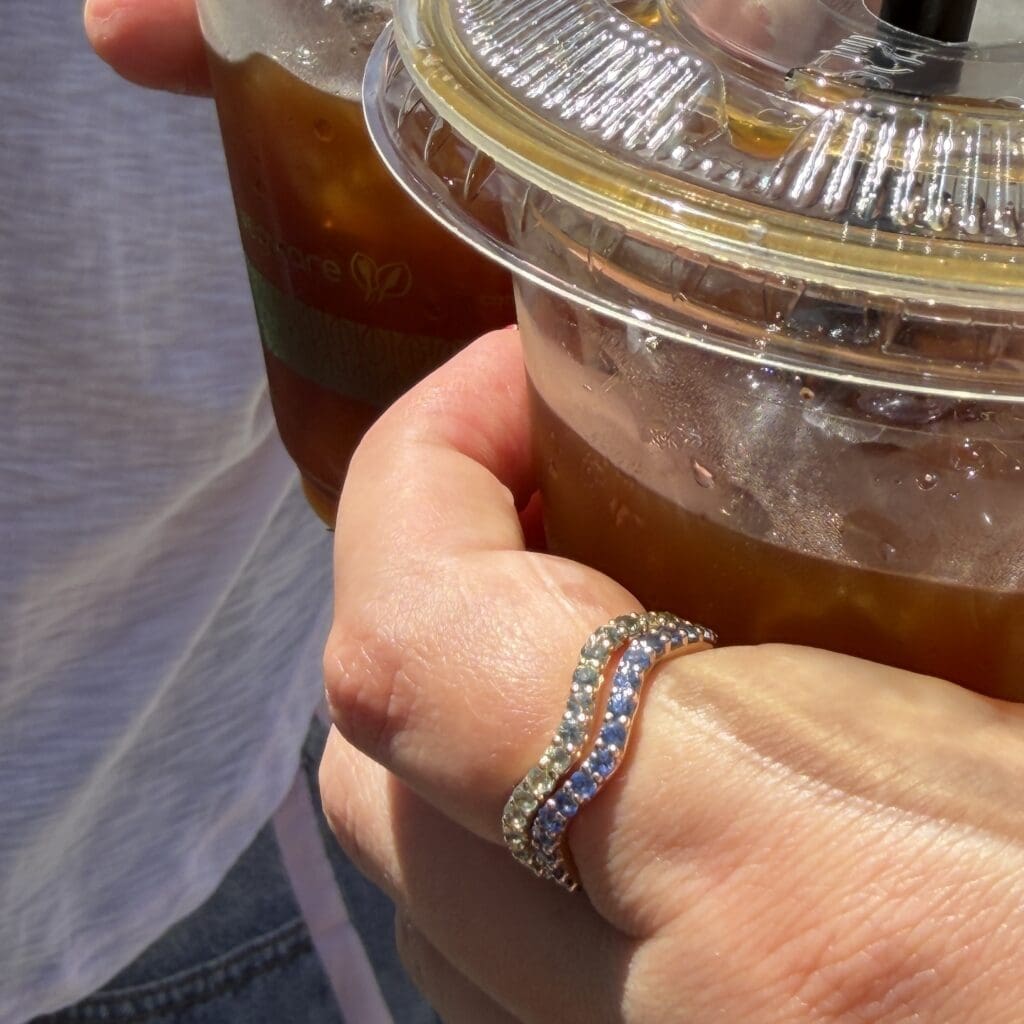
Two Dylann Wolfe Long Lull bands made with Colombian 14k Fairmined yellow gold and Colombian coffee. Photo by Chloe Beaumont.
Did you know that one of the countries that routinely produces some of the best tasting coffee also produces gold? Not only that, but completely traceable, artisanally mined Fairmined gold?
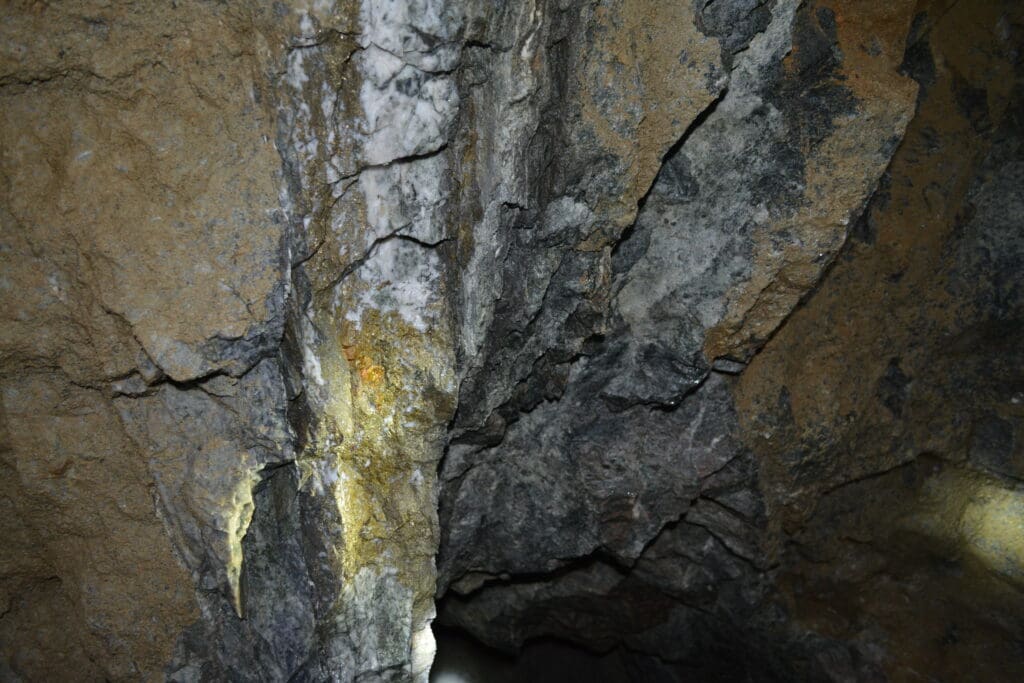
A gold vein in a Fairmined certified mine in Colombia. Photo courtesy of Alliance for Responsible Mining/Fairmined.
Colombia is one of the two countries with gold mines that are Fairmined Certified, meaning they have met the rigorous standards set by the Fairmined Standard, overseen by the Alliance for Responsible Mining (ARM).
The Fairmined miners from Iquira Cooperative mines actually started out as coffee farmers!
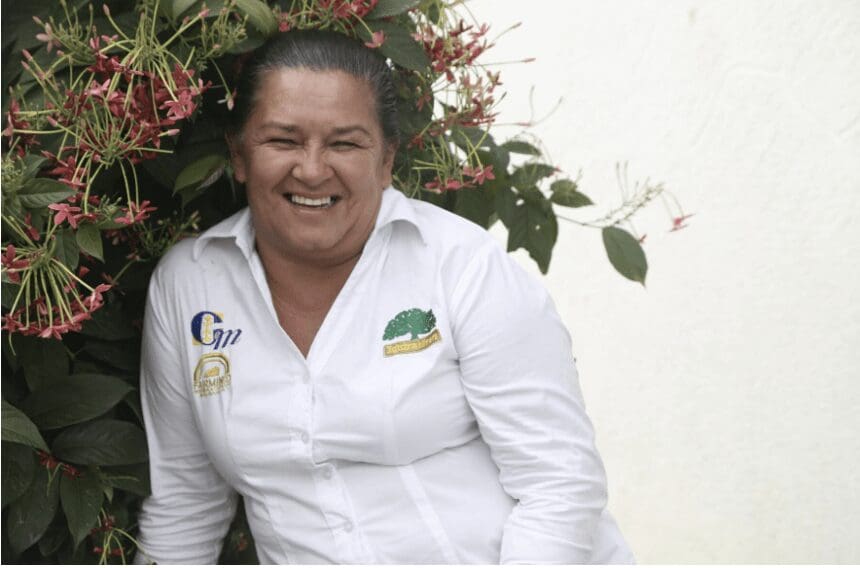
Mercedes Arias is 56 years old and has dedicated her life to coffee farming and gold mining. Photo courtesy of Alliance for Responsible Mining.
"Since mining started in our region, it has improved the lives of families with job generation." ~Mercedes Arias
In the early 2000s, several coffee farmers in the area began splitting their time between artisanal gold mining and farming. Thanks to early organizing efforts, they were able to organize and create the Íquira Cooperative in 2004 and obtain a registered mining title and official licenses from the Colombian government. The Íquira cooperative, characterized by a strong sense of unity and a loving spirit, has become aware of the positive impact that mining can have on its community thanks to the training workshops hosted by ARM.
Both men and women miners work at Iquira mines, and now they rotate seasonally between producing coffee and gold! The mine is conveniently located right in the heart of the Colombian coffee growing zone.
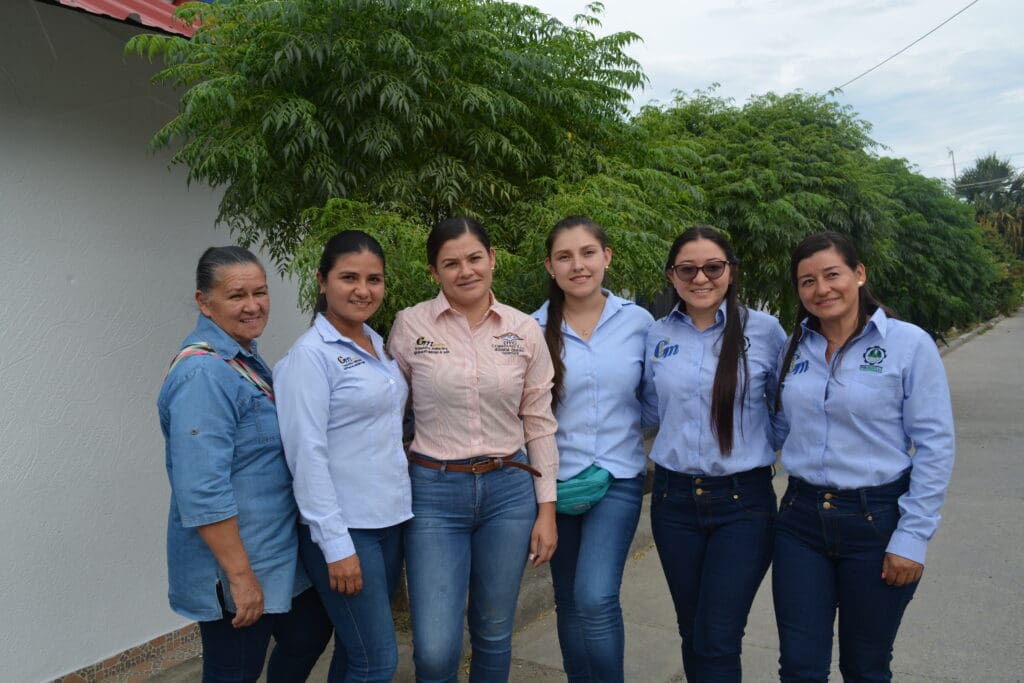
Fairmined women miners in Colombia. Photo courtesy of Alliance for Responsible Mining/Fairmined.
We are so used to seeing the Country of Origin on each packaged bag of coffee beans we buy. What if we could normalize the same thing for fine gold jewelry?
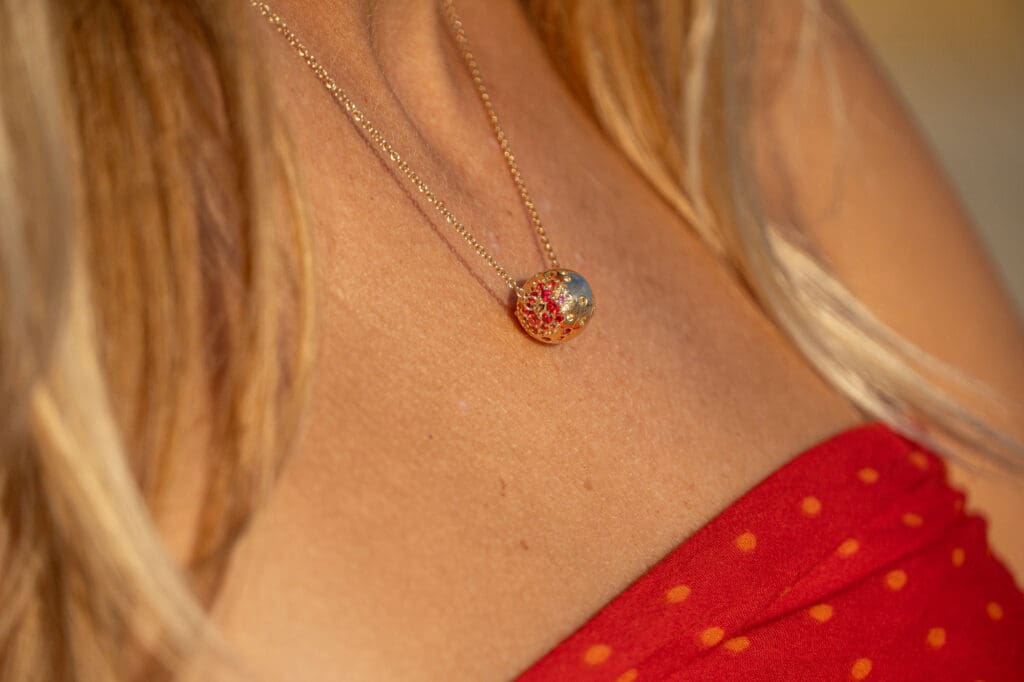
The Rolling Tides necklace in Golden Hour, featuring ombre sapphires and 14kt Fairmined yellow gold. Photo by Morgan Burger.
Each one of our Dylann Wolfe, Mazahri, co-founder Laura Beaumont’s and several of our Delphine Leymarie, WEND, and Mercurius pieces are made using this responsibly mined gold.
How exactly is it “responsibly mined”, you ask?
So many ways!
Each Fairmined Certified mine works towards implementation of technological changes in their processing plants so that they can mine without the use of toxic mercury. They each have managed occupational health and safety systems, along with annual training to make sure miners can mine safely. There are no discriminatory activities based on gender, race, religious beliefs, cultural minorities, etc, plus no child labor allowed, of course.
As far as the environment goes, Fairmined mining associations do not cut down trees or hunt wildlife near the mine site. Any wastewater generated at the plants visited is taken to tanks and recirculated. All the plants have closed cyanidation systems, where there is no discharge to soil or bodies of water. Reforestation of the disturbed area is planned for and implemented, to leave as minimal an impact on the local area as possible.
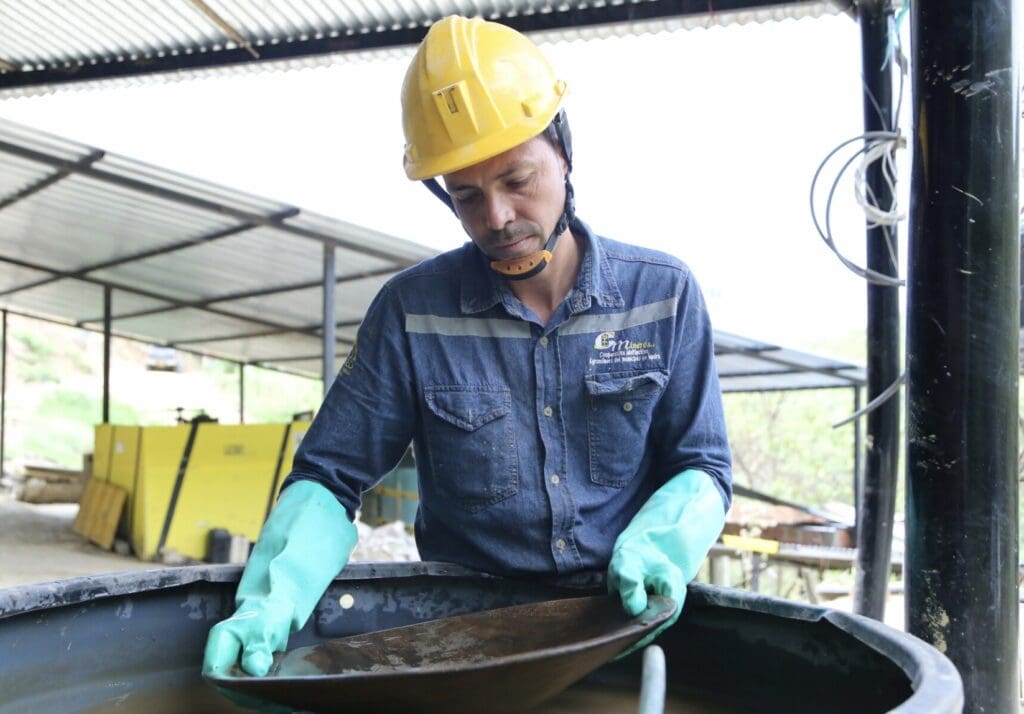
A fairmined miner sifting gold in a pan at a Fairmined mine site called Iquira in Colombia. Photo courtesy of Alliance for Responsible Mining/Fairmined.
Each one of the Fairmined Certified mines receives what is known as the “Fairmined Premium” as an incentive/reward to uphold these standards.
They receive USD $4 for every gram of Fairmined gold sold (extracted with responsible chemical management). And in the case of Fairmined "ECO gold" (extracted without the use of any chemicals) they receive USD $6 for each gram of gold.
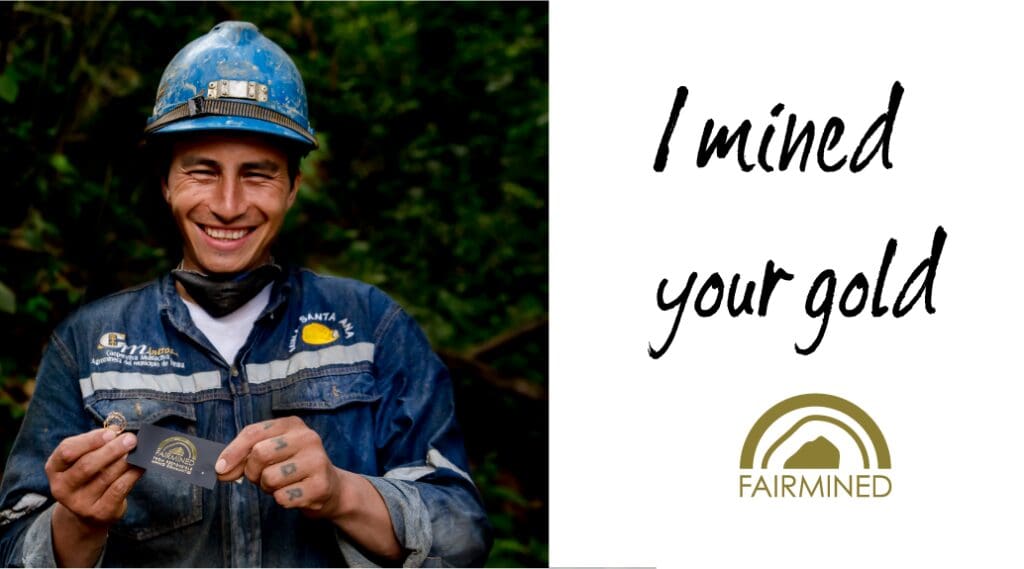
A Fairmined miner in Colombia holding a ring made of Fairmined gold. Photo courtesy of Alliance for Responsible Mining/Fairmined.
The premium goes towards strengthening responsible practices and the production system of the mining organization, well-being of the organization's members and their families, and social benefits.
One example of a social benefit to the community is the Hearts of Gold project, where Iquira co-op donated a percentage of their premium to children and adolescents with Special Educational Needs (SEN) who live in villages near Pacarní, Huila (Colombia) where the mines are. This funding provided language therapies, sign language and psychomotor stimulation therapies to contribute to their pedagogical, cognitive and psychomotor development.

A Fairmined miner looking out at the view from a mine site in Colombia. Photo courtesy of Alliance for Responsible Mining/Fairmined.
The second mining organization that is Fairmined Certified in Colombia is La Gabriela, located in the department of Antioquia, Colombia. They began mining twenty years ago as an additional economic activity alongside their rubber and cocoa cultivation. In 2007, the family created ponds to farm tilapia to provide for the workers. After adopting Fairmined certification, the mine transformed its practices towards responsible mining in 2021, becoming the first Fairmined certified mine in Tarazá.
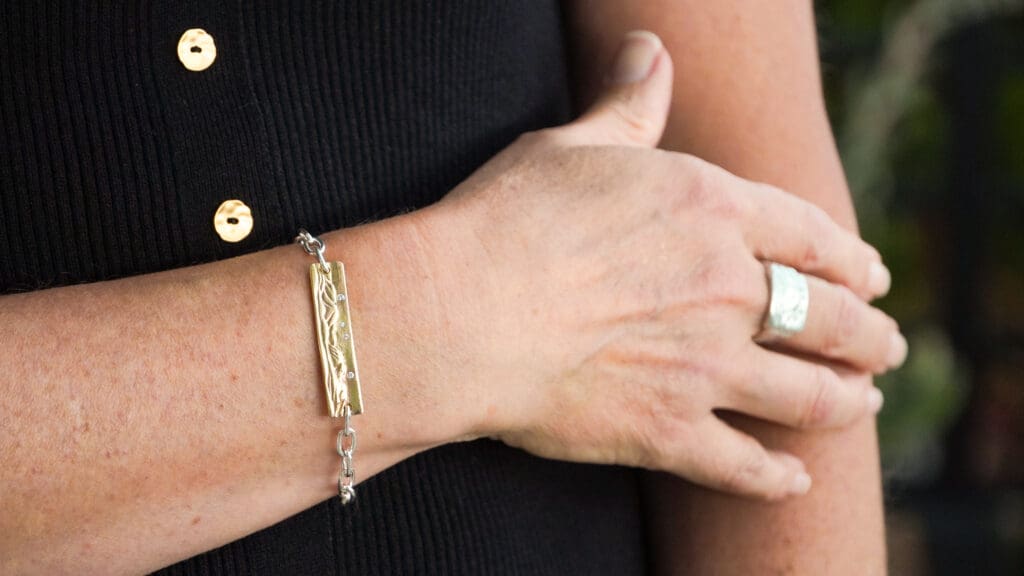
Our WEND Astral peaks dual tone bracelet and Astral Peaks ring, both made using Fairmined 14kt yellow gold. Photo by Morgan Burger.
In 2022, La Gabriela actually mined out all of the gold in the vein they had discovered, which is a natural occurrence with rocks but poses a significant challenge. This caused La Gabriela to have inconsistent production that year and, consequently, a dramatic drop in sales. The miners decided to focus the 2023 premium on refining their Work and Projects Program (PTO), which prioritizes exploring mineral reserves through sampling to make strategic decisions about mineral extraction within the mine.
Had the miners not had access to the Fairmined Premium, it is unlikely that they would have had this helpful “buffer” until they could figure out where to explore next.
For us here in the States, gold is a pretty adornment and can be deeply meaningful. But, it’s not going to make or break us if we don’t have it. However, for these miners, gold is their entire livelihood.
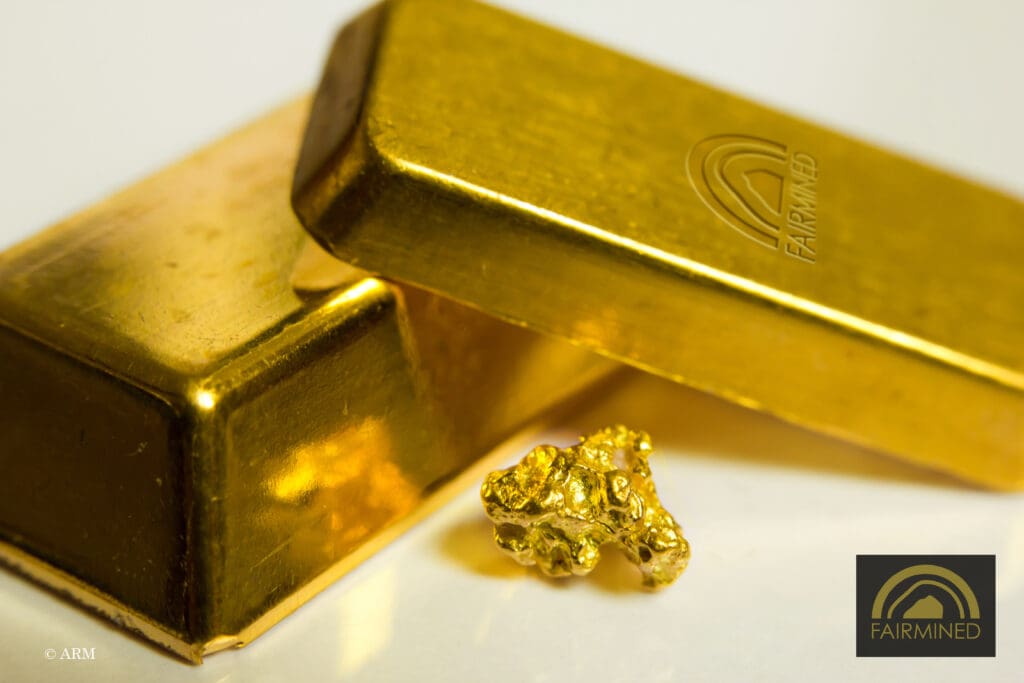
Bars and a nugget of Fairmined gold. Photo courtesy of Alliance for Responsible Mining/Fairmined.
By purchasing pieces made using Fairmined gold, you are helping support entire communities of men, women and children in Colombia.
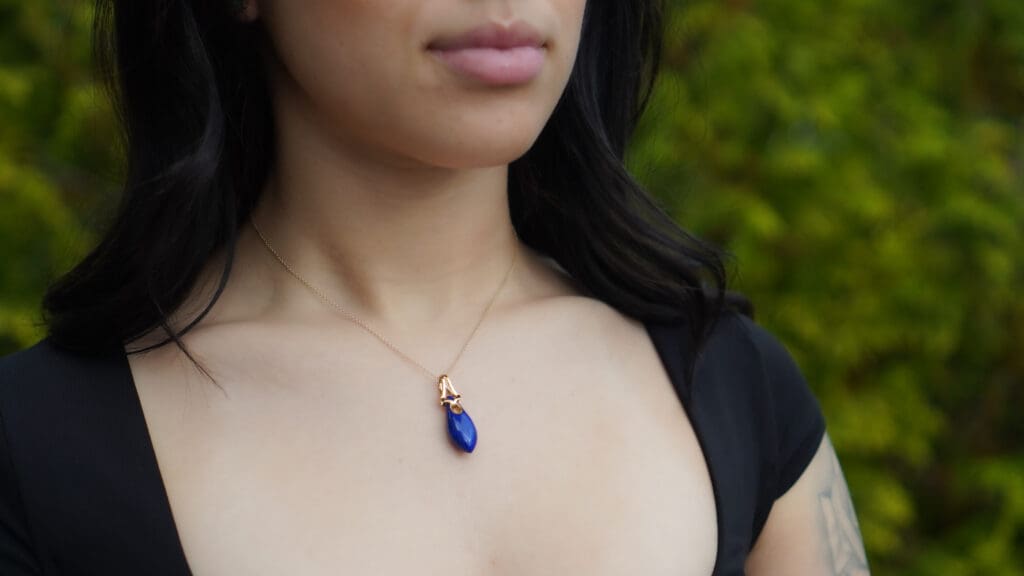
Our Lapis Lazuli tumbler pendant by Mercurius, made using 14kt Fairmined yellow gold. Photo by Morgan Burger.
We hope the next time you are drinking Colombian coffee, you think of Fairmined gold too– and we hope you will fall in love with one of our pieces so that you can wear it and enjoy your coffee at the same time every day!
Shop all our 14kt Fairmined gold pieces HERE, our 14kt Eco-Fairmined yellow gold pieces HERE, and our 18kt Fairmined yellow gold pieces HERE.
To learn even more about Fairmined gold and silver, read our first blog HERE.
We think this semiprecious, glowy stunner is quite underrated, and we hope after reading this blog you’ll agree!
Reason #1 Why Carnelian is Underrated: Carnelian is a type of Chalcedony that can actually be found in the US in places like the Oregon Coast (where we found some), Washington, Montana and Arizona.
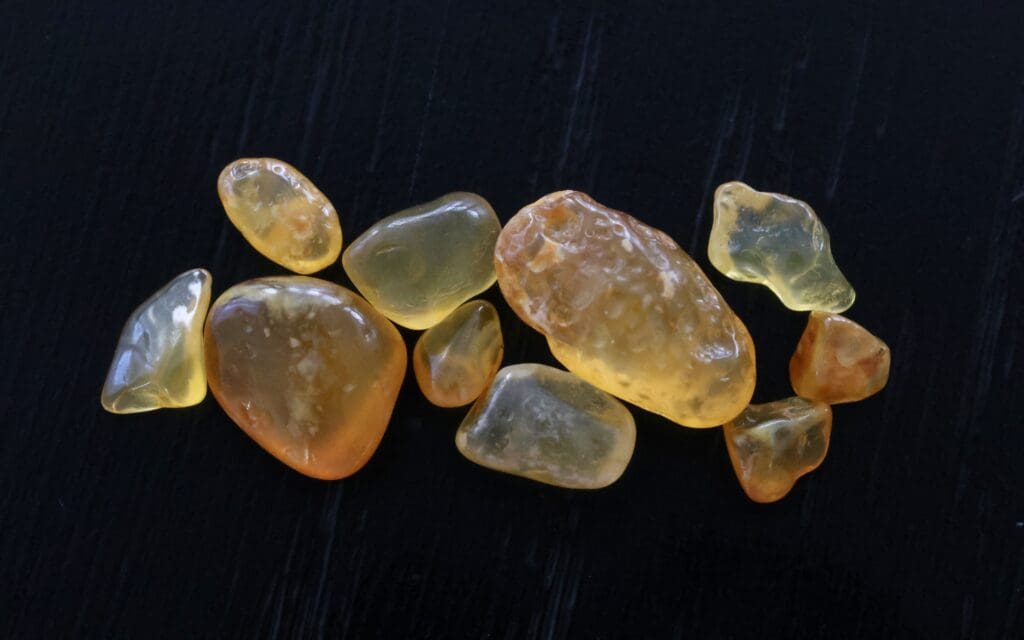
“Carnelian” is the trade name for when Chalcedony is orange, translucent, and evenly colored without any banding. If there are bands or white swirls present, then it gets called Agate.
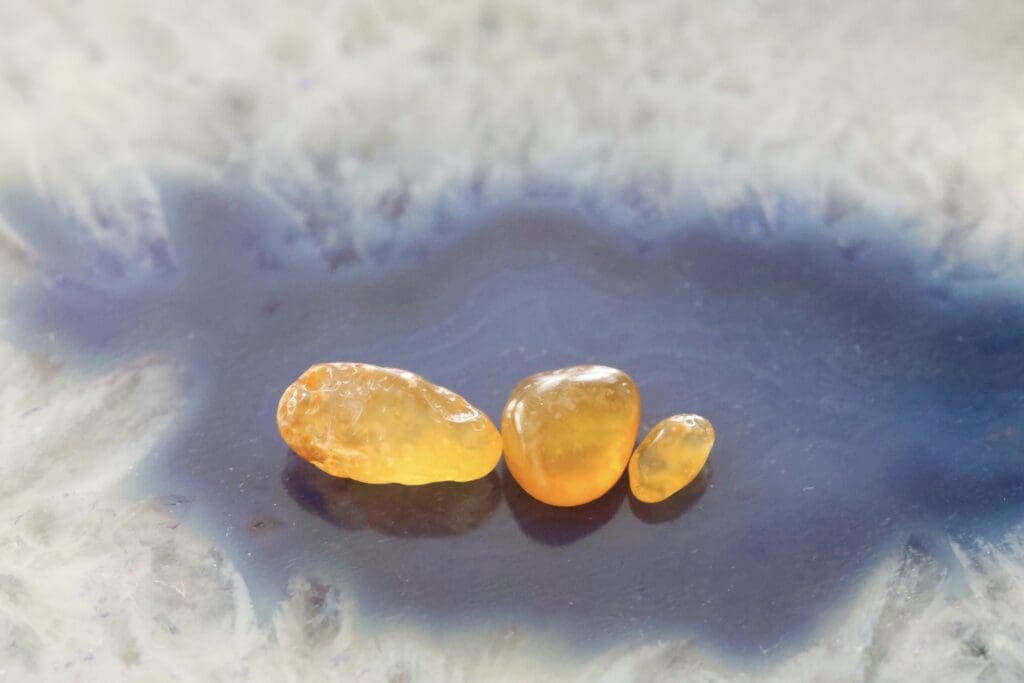
Reason #2 Why Carnelian is Underrated: When you buy Carnelian jewelry, you can get the sunny, saturated orange color you want without feeling like your bank account was just ransacked.
Carnelian is the most affordable type of Chalcedony, but still glows just as nicely as an orange sapphire or spessartine garnet (the latter of which has risen dramatically in price and popularity lately!)
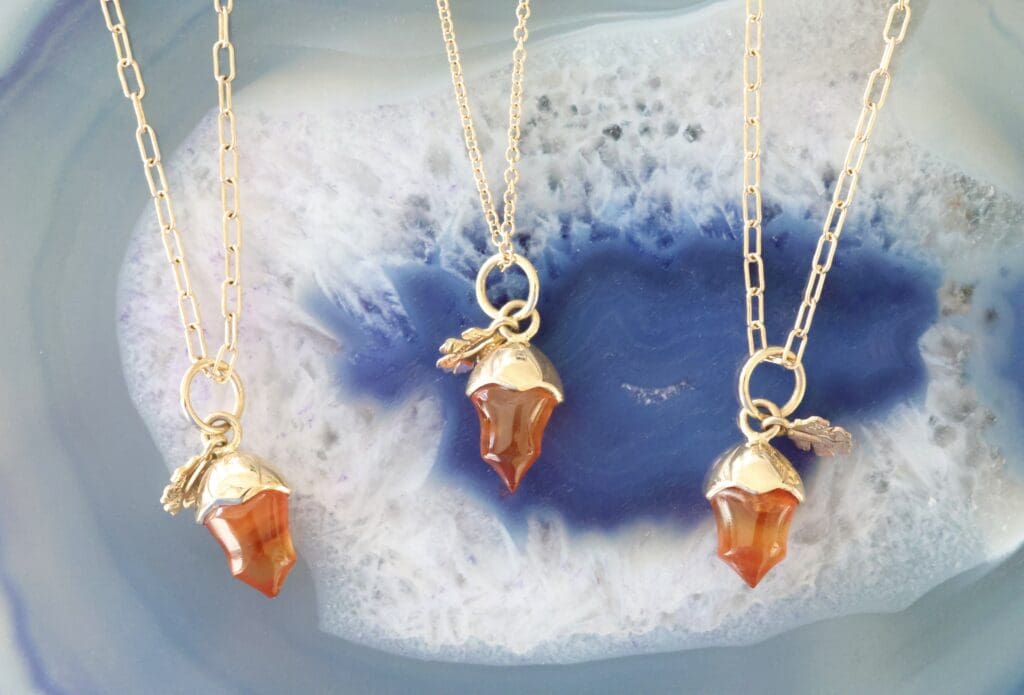
David and Alisa, the husband-and-wife duo behind Mercurius Jewelry, designed these adorable Mini Acorn Charms for you as a Beaumont Jewelry Collective exclusive. Each one has a little gold leaf and a unique Carnelian that was hand-carved by Dave himself, who is a master lapidarist.
They are pictured here on our Fairmined gold cable and paperclip chains, but we honestly think they’d be cute on any chain and would bring some warmth to your jewelry collection.
Reason #3 Why Carnelian is Underrated: It glows like fire in sunlight!
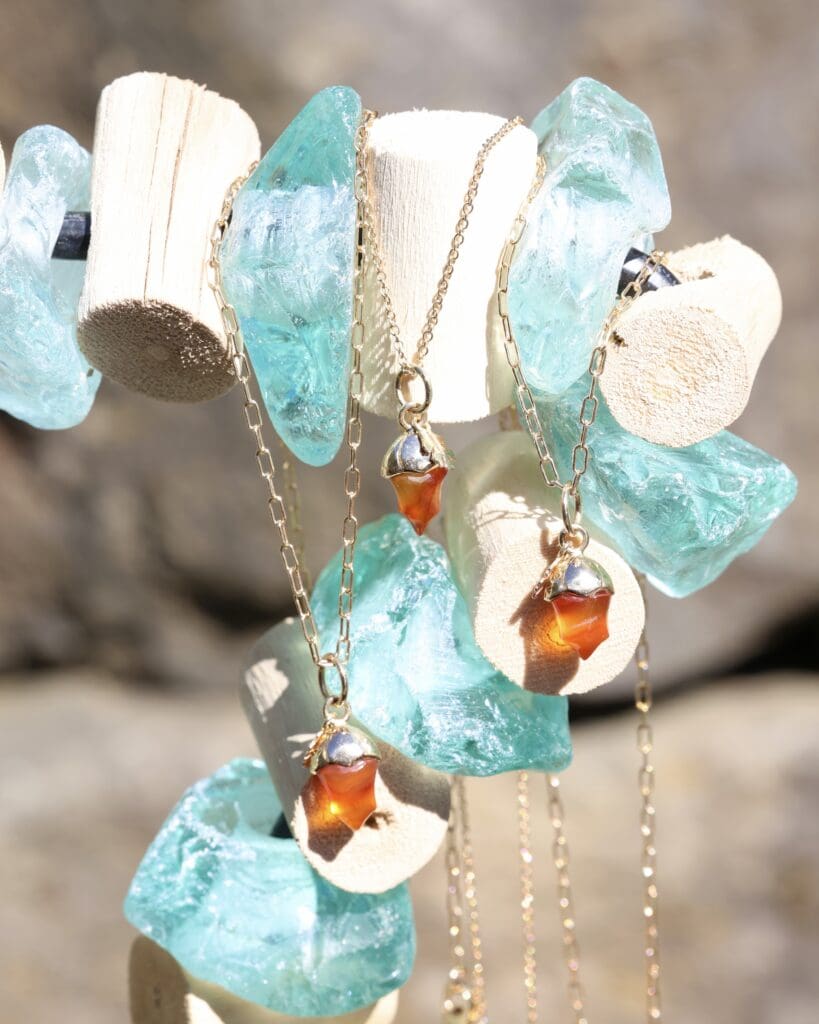
If you thought Carnelian was pretty in that indoor photo, just look at how they glow in the sunlight!!
We can totally understand why the ancient Indians who built the Taj Mahal called Carnelian “the fire stone.” Carnelian gets its orange hue from iron oxide found in its trace inclusions from when the stone was forming. In Arab tradition, Carnelian was considered a stone for the kings due to its association with fire and having a protective, proactive energy.
Would you wear a Carnelian necklace? We hope this interesting gem grows on you just like it has on us!
At a glance: the sea blue variety of the mineral species Beryl, March's birthstone Aquamarine with its soothing hues has historically been a crowd pleaser.
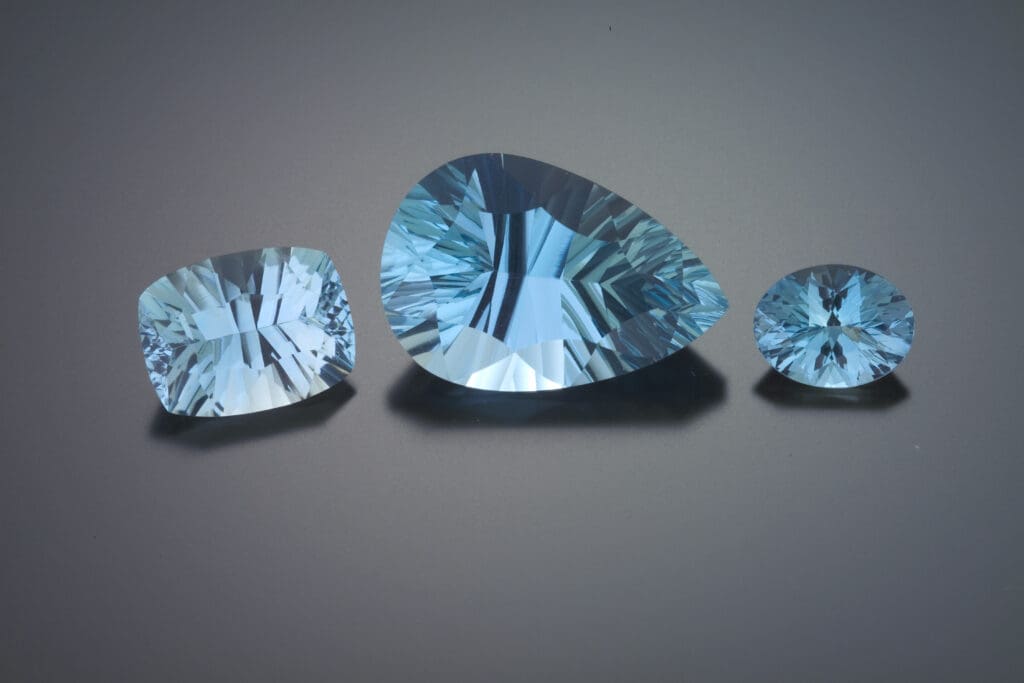
Color
Aquamarine (meaning "seawater" in Latin) comes in shades of light, pastel blue all the way to deep saturated aqua, sometimes with a strong greenish tint. Its gorgeous hues reminds us of the crystal clear waters of the Caribbean!
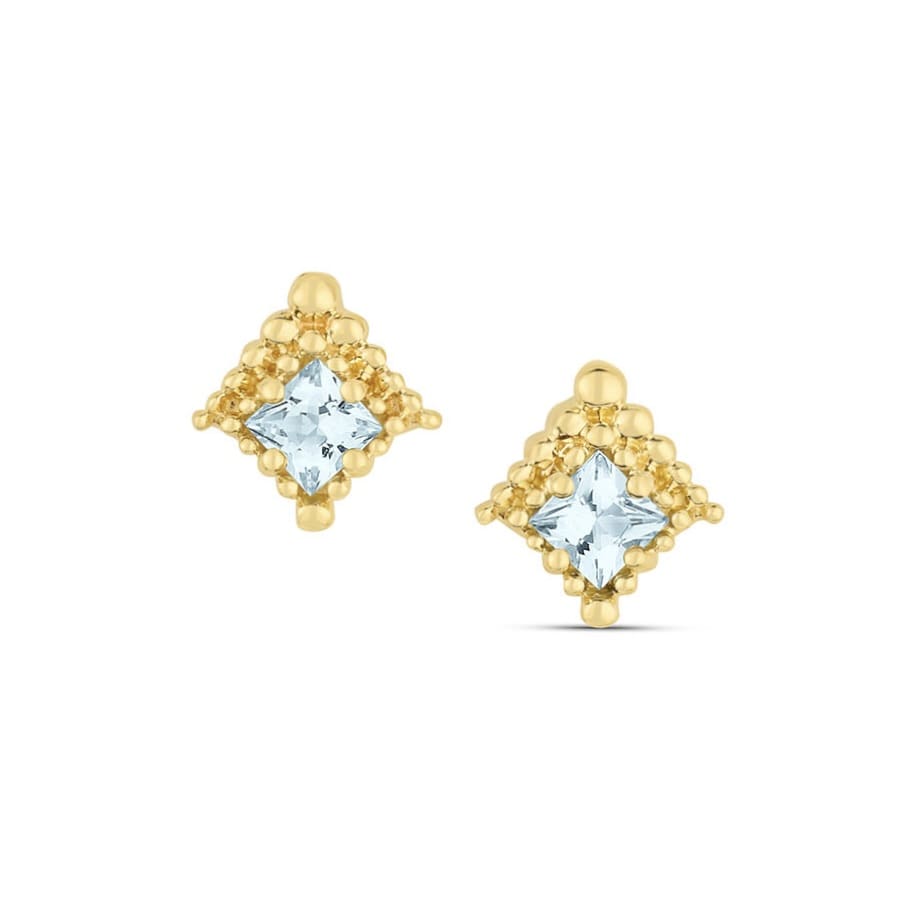
Durability
Aquamarines are a 7.5-8 on the Moh's Scale of Hardness, making them durable enough for daily wear. They are not as hard as diamonds and sapphires, however, so they are a bit more susceptible to scratching. If you own an aquamarine ring, exercise more caution when wearing it than you would with diamond rings. Using warm water and mild soap on aquamarines is always fine. You should double check to make sure your aquamarine doesn't have any surface-reaching fractures or large inclusions before submerging it in an ultrasonic cleaner.
Symbolism and History
In the ancient past, mariners and sailors believed that aquamarine would protect calm waves and protect them while they were at sea. According to Greek mythology, Aphrodite adorned her daughter's hair with aquamarines as an expression of divine love. Aquamarine later became a popular bridal gift as it was thought to bring happiness in marriage. In color psychology, blue is often recognized as one of the most tranquil colors that is known to reduce stress and even lower your heart rate!
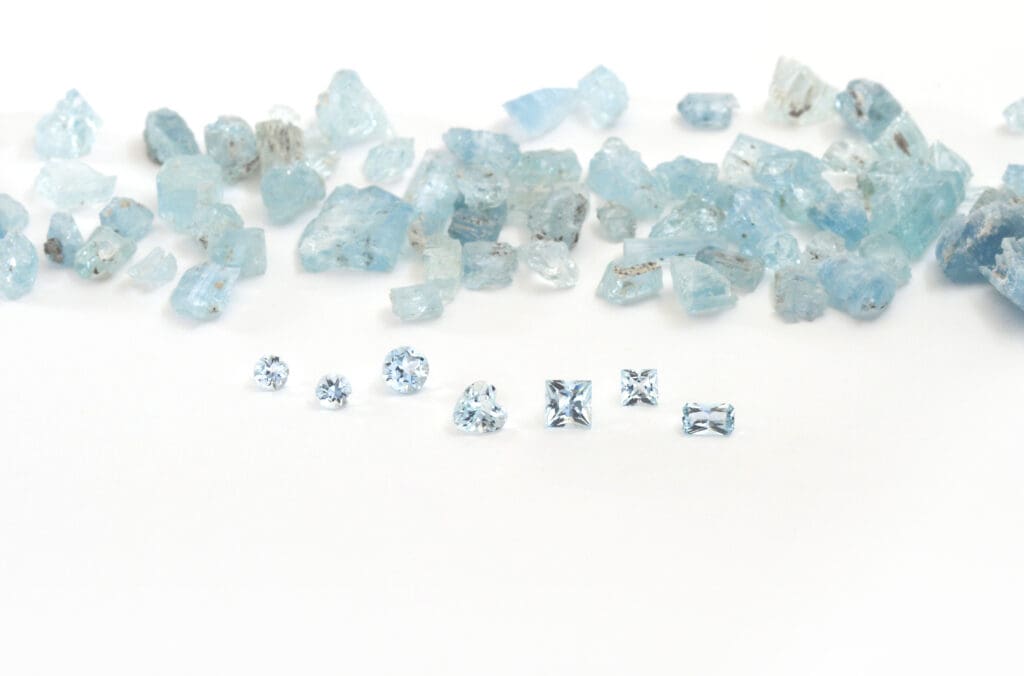
Where Aquamarines Are Found
Aquamarines can grow in massive crystals and is found in many different places all over the world. Brazil and Pakistan are two top producing countries, along with Kenya, Madagascar, Nigeria, Zambia and Mozambique. Did you know we even have American Aquamarine that comes from mines in Colorado?
We love this clear, dreamy colored gemstone jewelry here at BJC and can't wait to add more Aquamarine pieces to our collection!
Garnet’s stunning varieties are so underrated in our opinion, even though awareness about these juicy gems has been expanding!
Reason #1 why garnets are underrated: some garnets have even greater color dispersion than diamonds!
Demantoid garnet, the most highly sought after type of andradite garnet, has better color dispersion aka “fire” due to its high refractive index and specific chemical composition. It simply splits white light into spectral colors more effectively! On top of that, demantoid garnet becomes even more valuable when it contains a special “horsetail inclusion” that resembles….you guessed it, a horse’s tail.
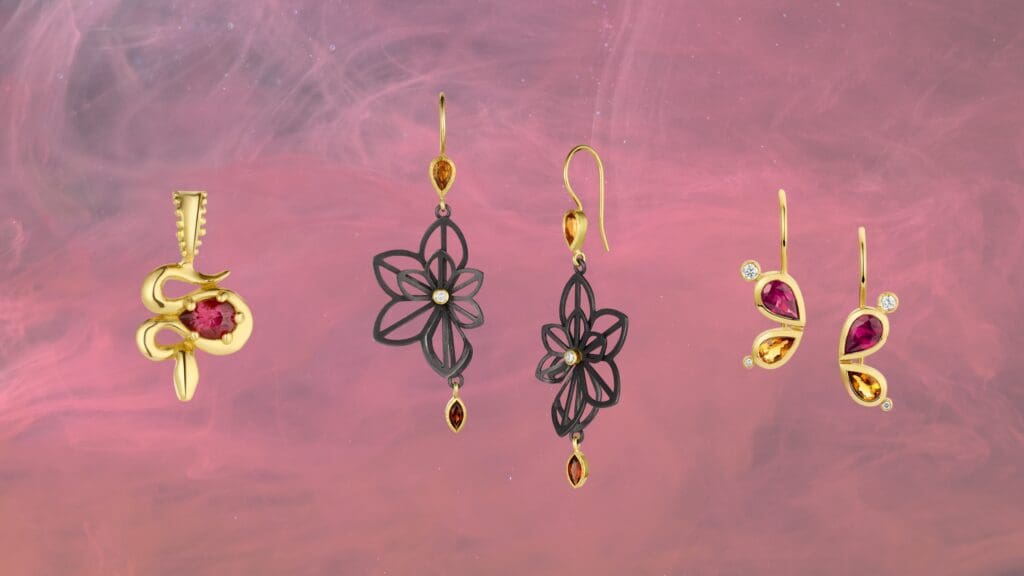
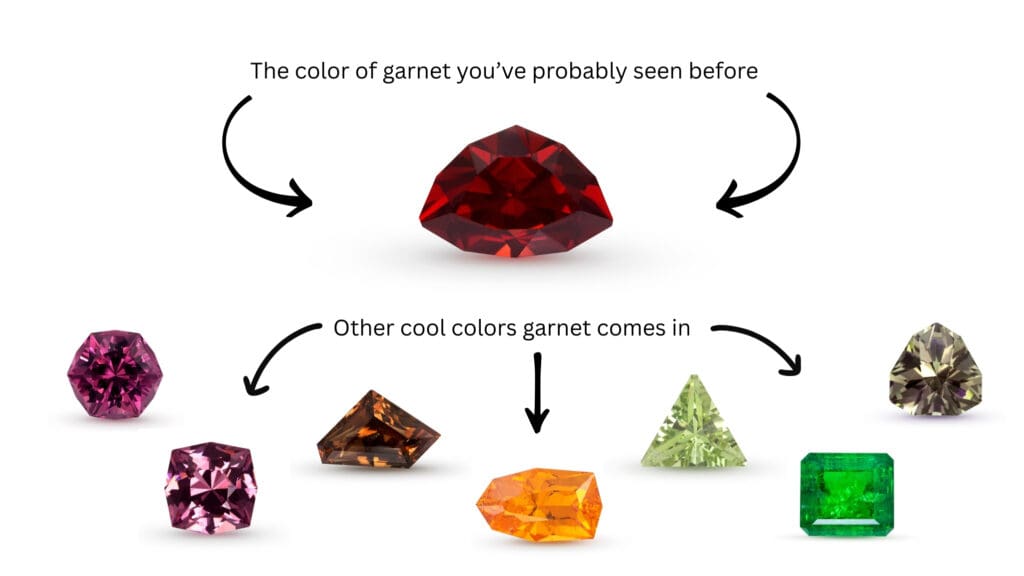
Reason #2 why garnets are underrated: garnets come in SO many different hues!
You might associate garnet with the color red, but in reality garnets come in 15 different species that produce gorgeous neon oranges, raspberry and blush pinks, vivid greens, honey brown, lemon yellow and even uber rare color change blue-to-purple.
Whether you are into raspberry-colored rhodolite (such as the garnets shown in the 3 pieces of jewelry we’ve curated above) or punchy green tsavorite that almost looks like an emerald, or more subdued pink malaya…garnet has got you covered.
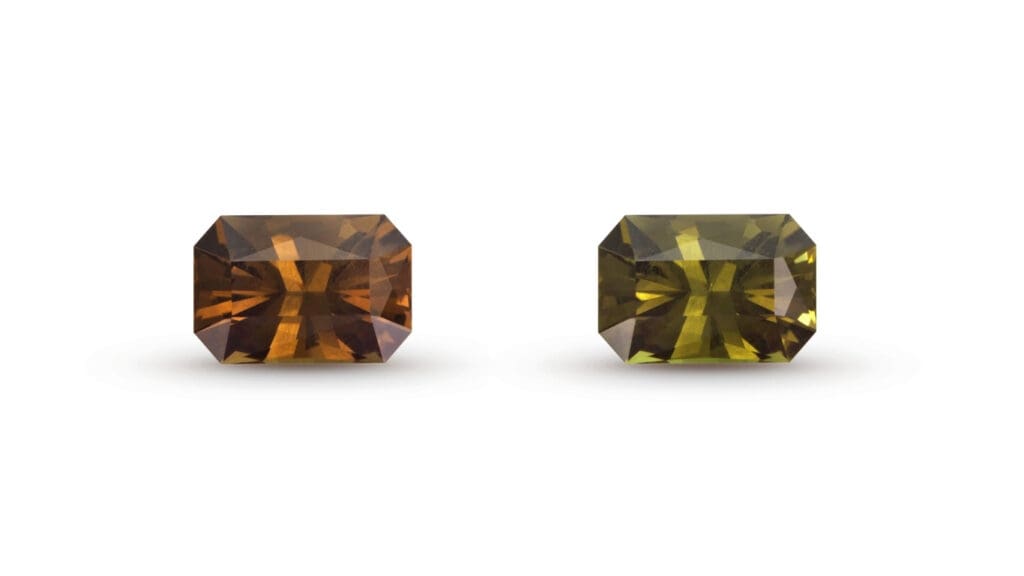
Reason #3 why garnets are underrated: some garnets are color-change, meaning they can show two completely different colors under different lighting conditions!
Not all gemstones can exhibit color change, which makes the ones that do rare and special. This phenomenon is completely natural, and many of these garnets are actually a blend of multiple garnet species. Garnets can show blue-to-violet, pink-to-purple, brown-to-green, purple-to-red, and even teal-to-purple. East Africa, where one of our awesome suppliers ANZA Gems sources from, is known to produce top quality color changing garnets. Owning a color-change gemstone is like having two gems in one!
Garnet is simply a downright versatile, endlessly interesting, fun gemstone. We are convinced the more varieties you see of them, the more you'll fall in love with them!
A vibrant stone that has been used in Eastern jewelry since ancient times, lapis lazuli is massively underrated!
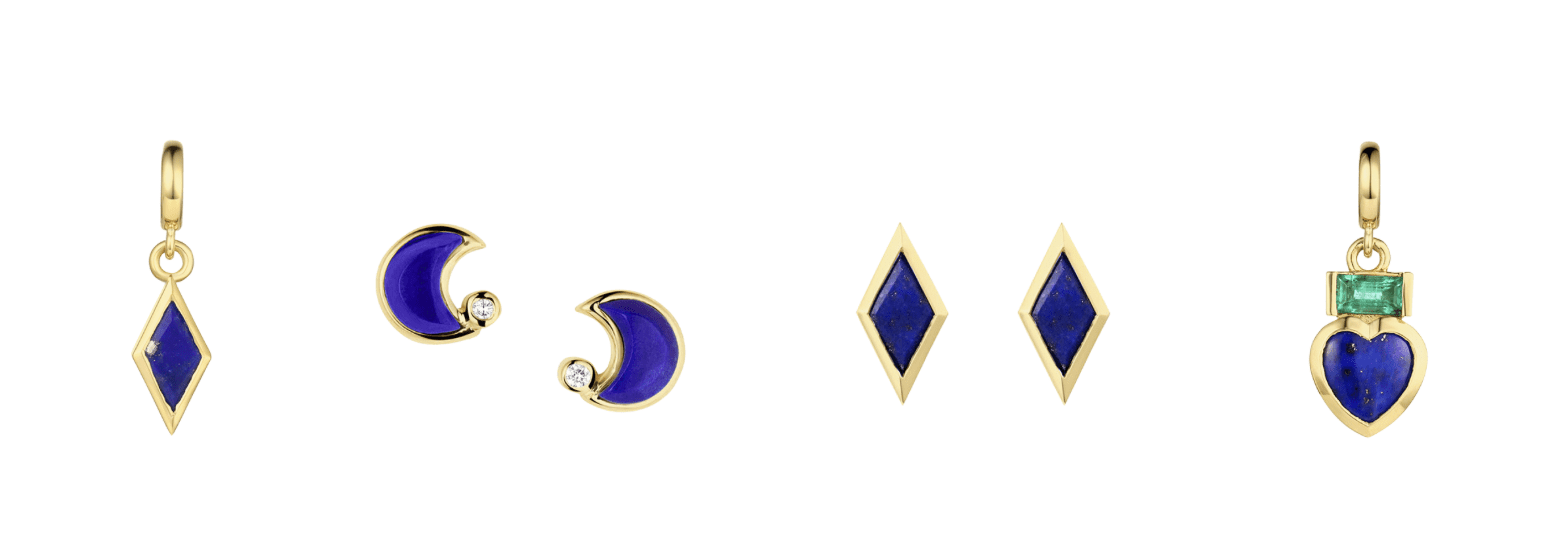
There are few gemstones that are as rich in saturation as Lapis Lazuli, and that is one of the many reasons why we love it so much. For thousands of years, the only known source of “Lapis” for short was Afghanistan, and it was traded far and wide across the Middle East, Europe and Africa for use in jewelry and cosmetics. The ancient Egyptians even used powdered lapis as medicine! Today, Lapis is also mined in Chile and Argentina, but many people still highly prize the Afghan variety as it has the deepest blue hue.
One of the coolest things about Lapis Lazuli is that it’s actually a combination of three different minerals: lazurite, pyrite, and calcite. The pyrite is responsible for the little “gold flecks” that you often see, while calcite can give it white patches or streaks.
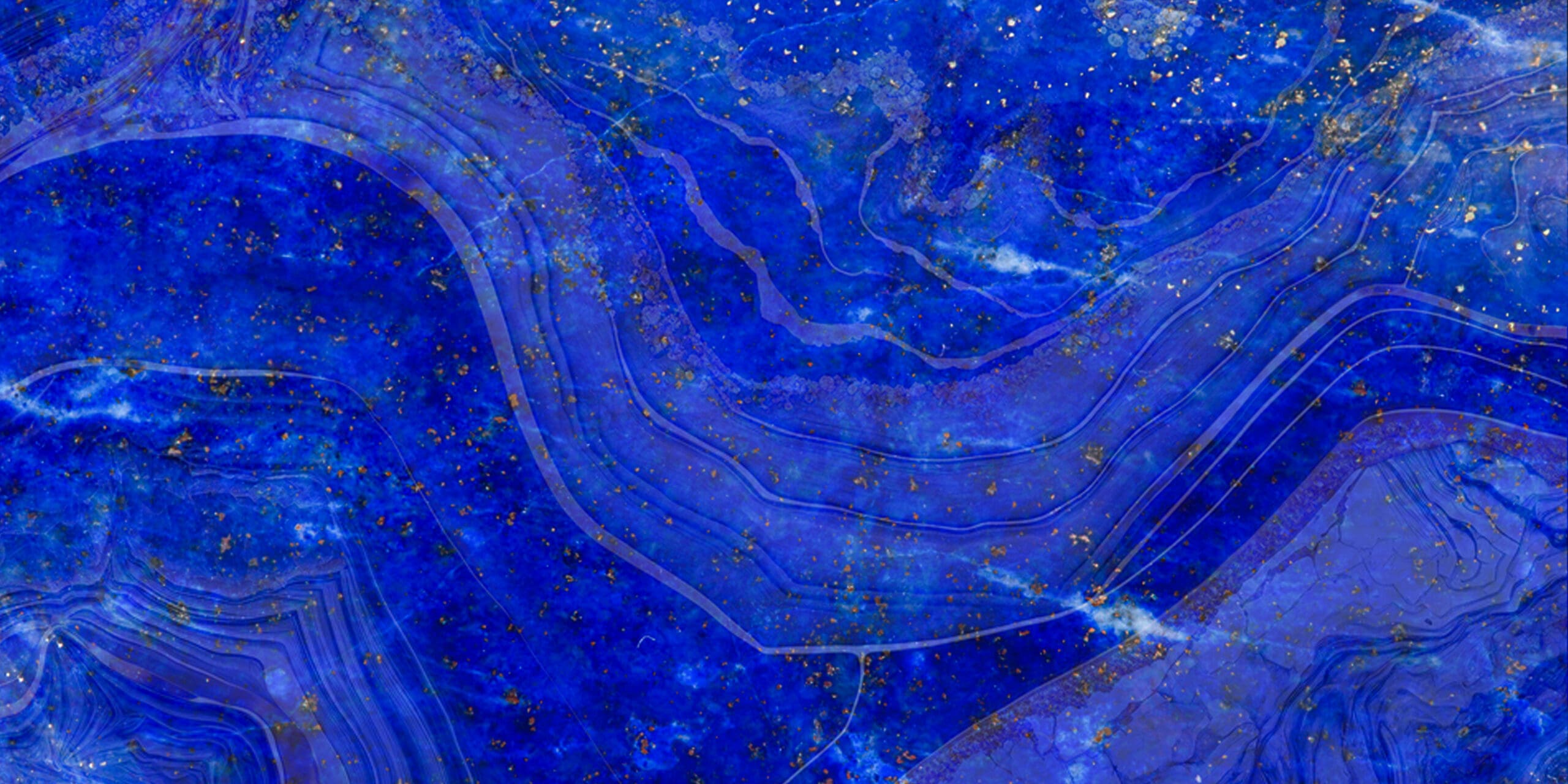
Not all Lapis that is carved or faceted has calcite patches, so don’t be surprised if you don’t see any! Many cutters will choose sections of lapis that have the most even deep blue color, with minimal to no white and maybe only a few pyrite gold flecks.
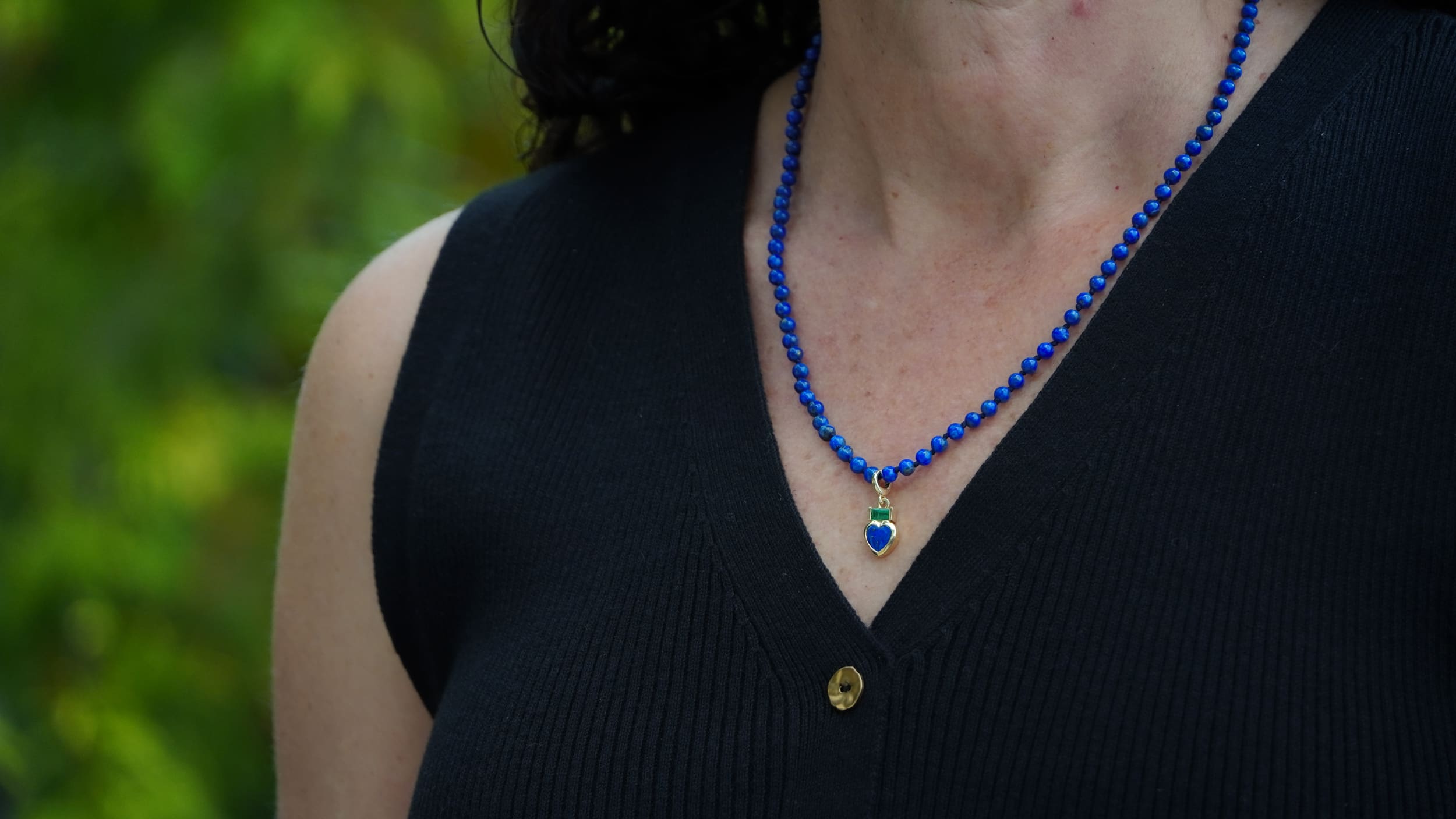
Another one of our favorite things about Lapis is the fact that jewelry designers can do so many different things with it, such as using it for bead strands, carving it into pendants, or using it as inlay (just like the ancients used to!).
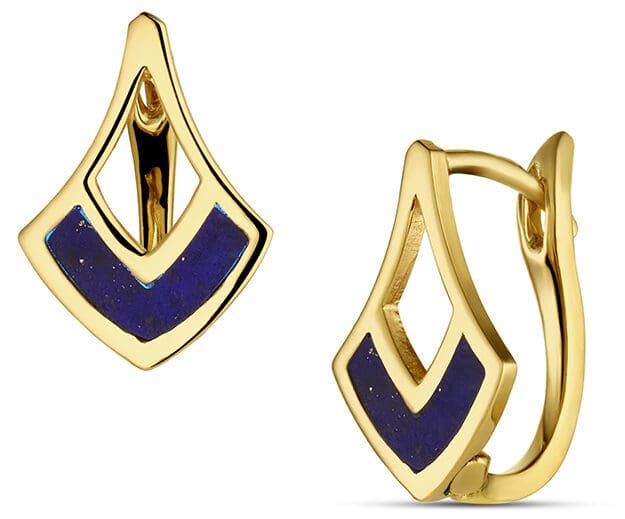
Lapis Lazuli’s versatility and vibrancy has truly stood the test of time. We hope you fall in love with this classic blue hued gemstone and find a piece that speaks to you!
At a glance: they come in all different colors, they’re very durable, and they are classic gems that will never go out of style!
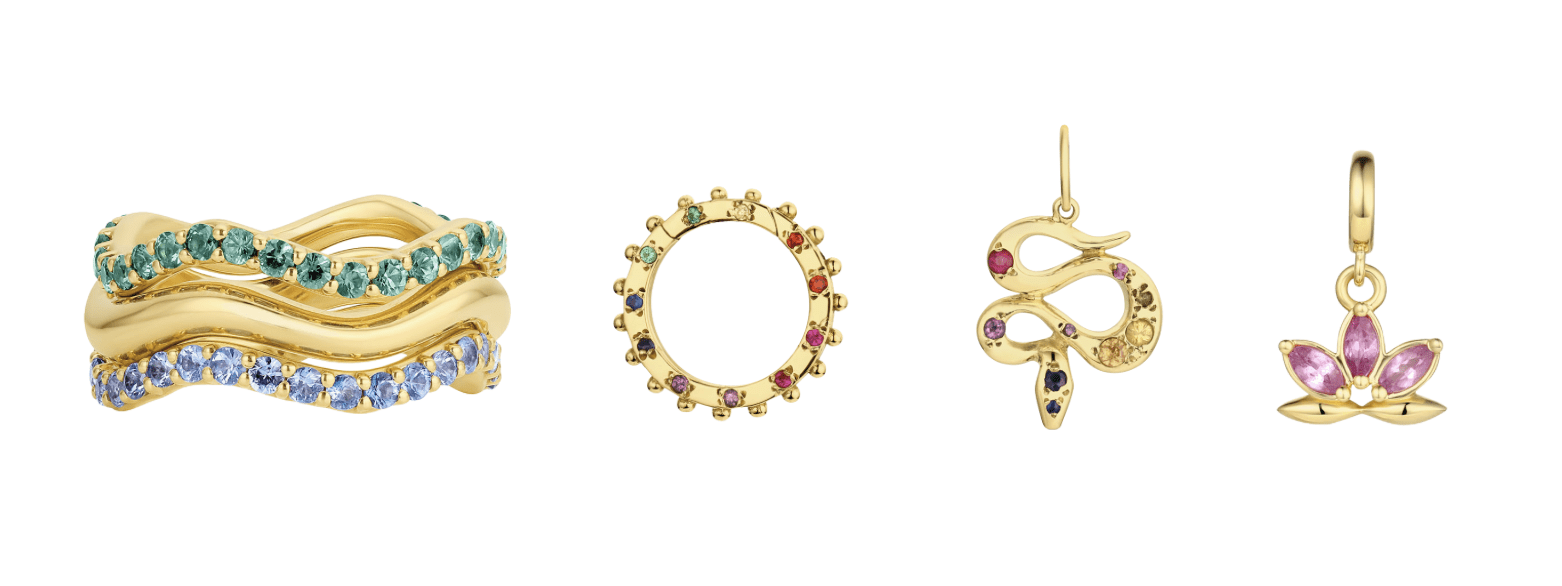
Sapphires are truly magical. Most people associate sapphires with the blue variety, but they actually come in every color of the rainbow, even black, white, grey, and beige! In fancy gem nerd speak this is called “allochromatic”.
There’s one exception: red. We call those rubies!
Yes, rubies and sapphires come from the same mineral species: Corundum. At what point a pink corundum can be called a ruby or a sapphire is still hotly debated, but in general, to classify something as a ruby it must have a medium to high level of saturation, without any strong secondary hues such as orange or brown.
Some types of sapphire are more rare than others, such as padparadscha sapphire and star sapphires that display the phenomenon known as “asterism”.
When it comes to jewelry, sapphires are a great gem that can withstand everyday wear. They rank a 9 out of 10 on the Moh’s scale of hardness (the ease or difficulty with which it can be scratched). Sapphire's durability has led to them becoming an increasingly popular choice for engagement and commitment rings.
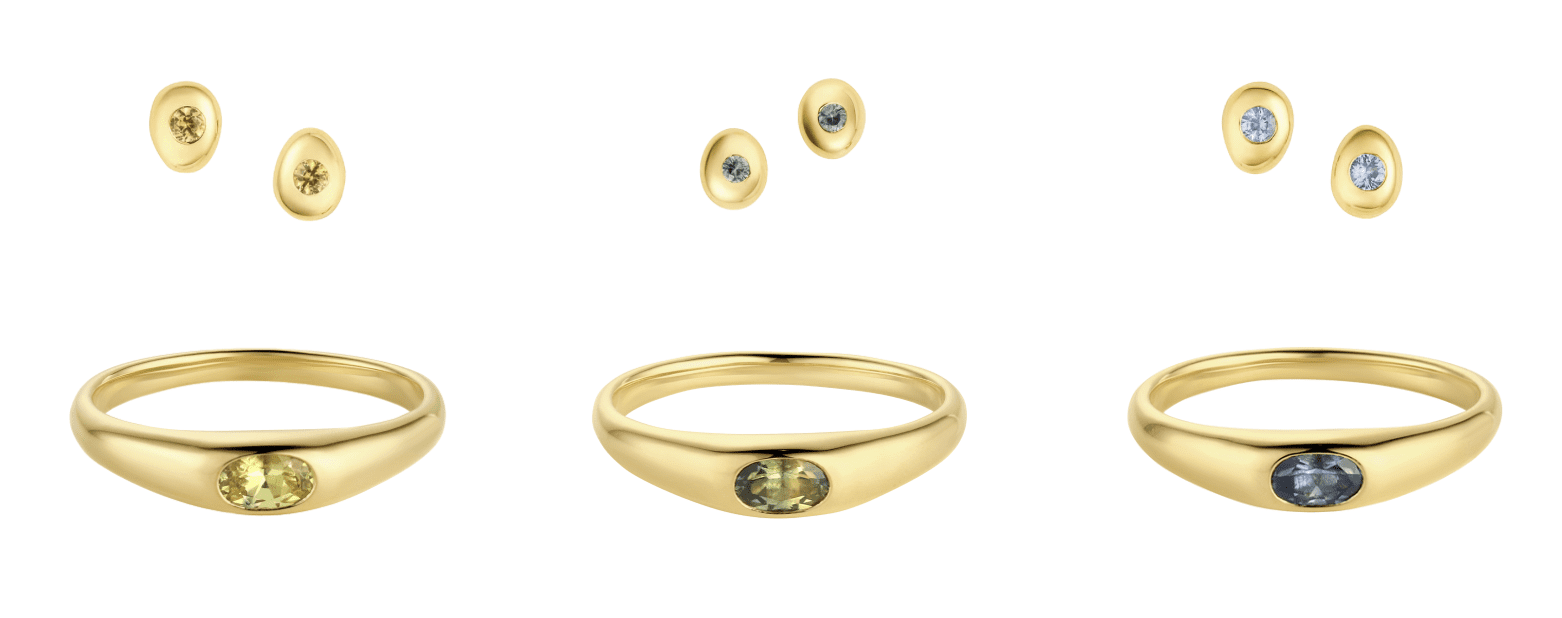
Sapphires are the birthstone for September and truly transcend time–they’ve been popular since the Middle Ages! Since sapphires have been worn and cherished across the globe for centuries, they have come to be associated with many things.
Two of the biggest? Royalty and romance.
In Ancient Greece and Rome, sapphires were worn by royalty for protection against envy and harm. Many people in the Middle Ages associated sapphires, especially blue ones, with heavenly blessings.
“Sapphires possess a beauty like that of the heavenly throne; they denote…those whose lives shine with their good deeds and virtue” —-Marbode of Rennes, 11th century poet
Blue sapphires became even more sought after when Britain’s Princess Diana wore one in her now-famous engagement ring.
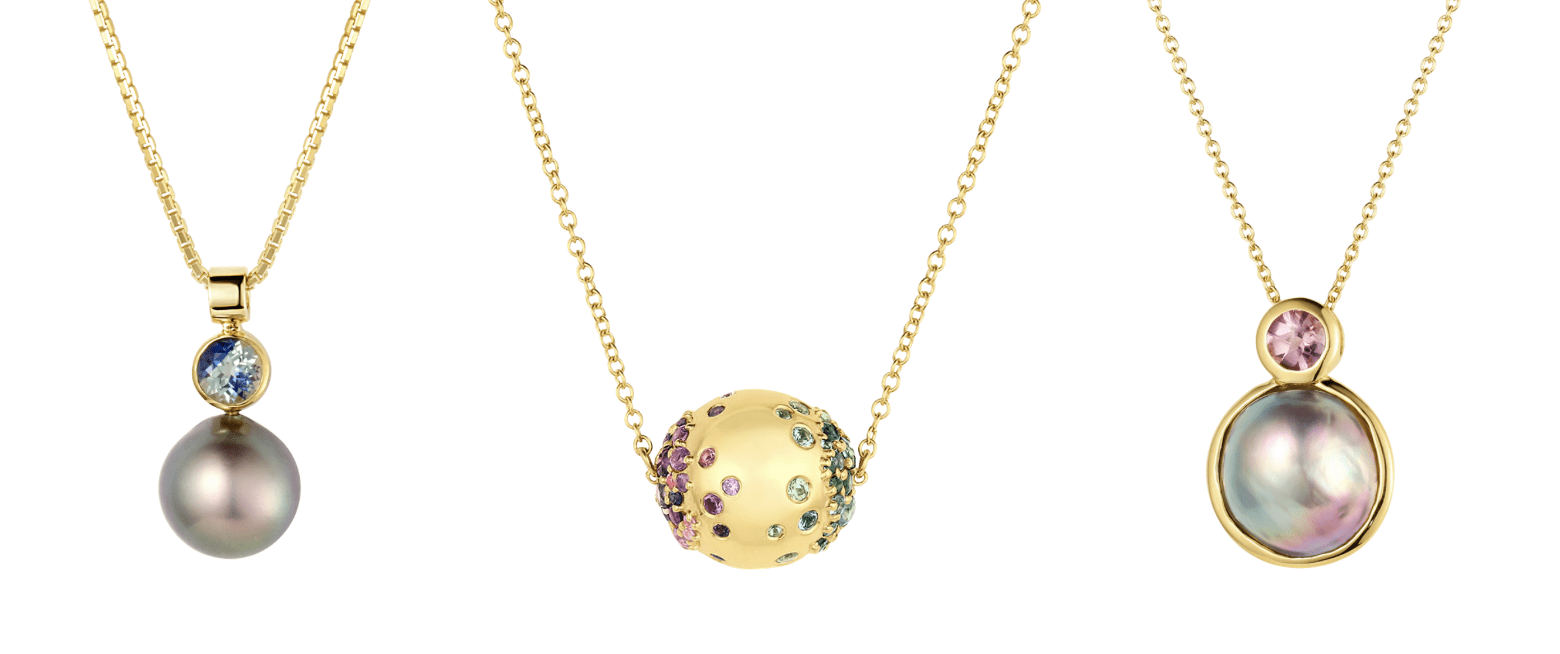
So many places all over the world!
The top sapphire-producing locations are Montana (US), Kenya, Tanzania, Malawi, Nigeria, Madagascar, India, Sri Lanka, Myanmar/Burma, Thailand, Cambodia, Vietnam and Australia.
Each one of these countries produces different colors, qualities, and sizes of sapphire rough. Often, one location will become known for a specific color if there is a lot of gem quality material in that hue (for example, Montana teal sapphire, or Sri Lankan “Ceylon” blue sapphire).
Sapphires (along with all other colored gems) get their color from their trace minerals and inclusions.
While some may view inclusions as “flaws,” we view inclusions as special and wondrous characteristics that make up a part of a gemstone’s “inner world.” Plus—no two gems have the same exact inclusions, so you can think of it just like a unique identifying “fingerprint!”
That being said, if certain inclusions are ever overly distracting, or if a gem dealer wants to improve the color and uneven tone of a gem, heat treatment can be a good option.
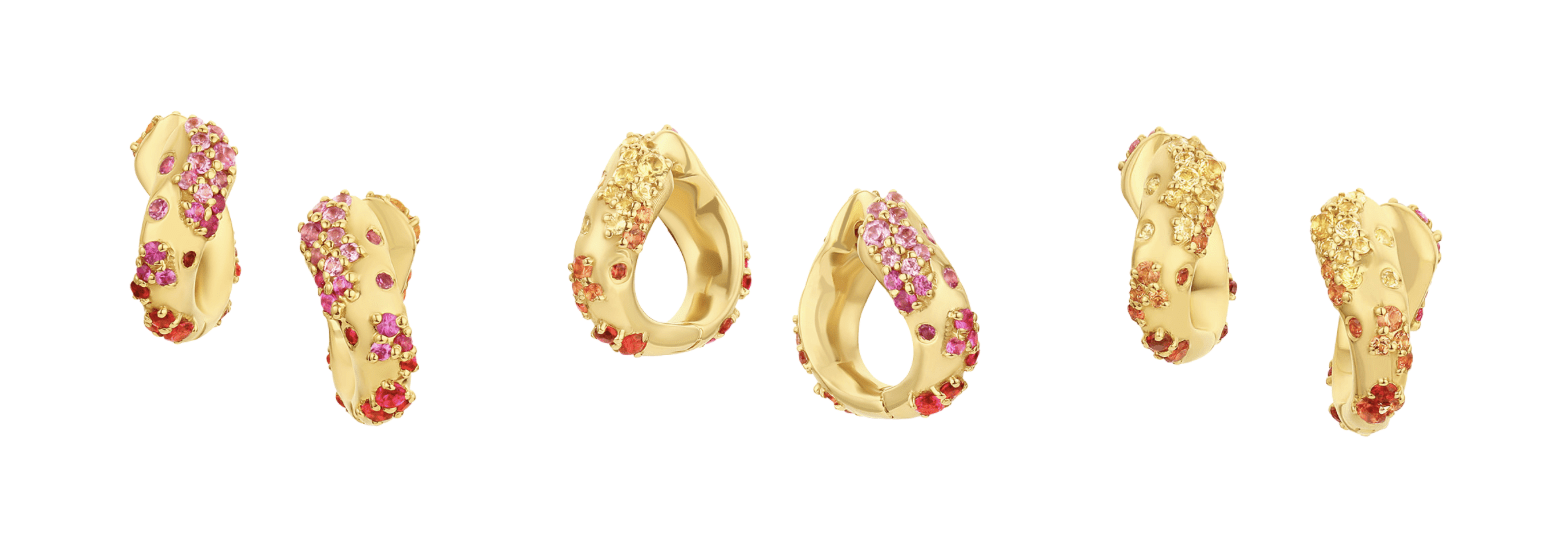
Heat treating sapphires is a very common practice throughout the gemstone industry, and is generally accepted by consumers. Countries like Sri Lanka have a very long history of heat-treating gems, whereas locations such as Bangkok, Thailand have become hubs for treatment more recently.
While non-heated sapphires are more rare, here at BJC, we support and love heated sapphires just as much as non-heated sapphires. The most important thing for you to consider when buying sapphire jewelry is that any heat-treatment is disclosed.
Due to sapphire’s durability, they can withstand being submerged in an ultrasonic cleaner. If you don’t have an ultrasonic, warm soapy water and a brush will also do just fine!
At a glance: As the rich green variety of Beryl and one of the “Big Three” gemstones, Emerald’s ethereal glow has withstood the test of time.
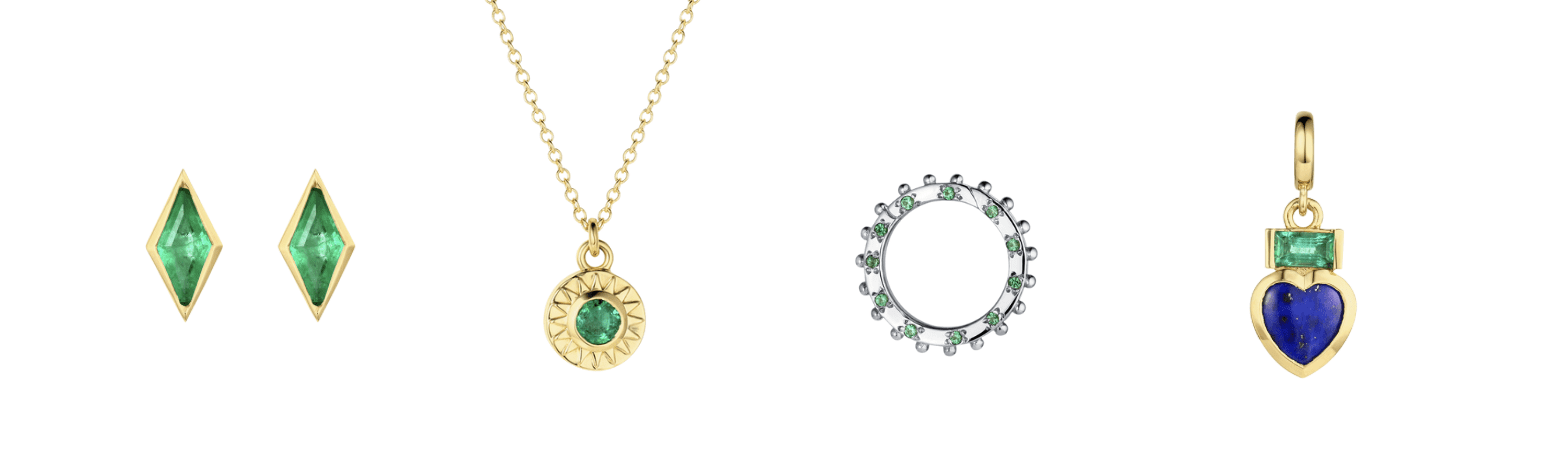
To be considered an emerald, a gem must be a bluish green color and medium-to-deep in saturation. Lighter or pastel greens are simply referred to as “green beryl.” The trace minerals chromium, vanadium and iron are what give emerald its rich green color.
“Nothing greens greener than emerald”
—Pliny the Elder, Natural History
Most emeralds have many inclusions (internal clarity characteristics) that are a part of their natural formation in the earth. Natural emeralds are known for this to the point that a great way to tell synthetic (man-made) emeralds from natural ones is if the gem looks “too perfect” or you can’t see a single inclusion.
We happen to love and appreciate natural emerald’s inclusions as unique markers of each gem that help to give them their ethereal “glow!”
Emeralds rank 7.5 to 8 out of 10 on the Moh’s Hardness Scale, meaning they are a bit more susceptible to scratching than other gems such as sapphire and diamond. However, Emerald’s main “caution point” is its brittle nature. Emeralds that are worn in rings must be looked after with great care. They are better worn in earrings and necklaces as these types of jewelry typically are not subjected to nearly as much contact with other day-to-day items.
Does this mean you should never wear emerald rings? Of course not! You should just be sure that the setting of your emerald is the most protective it can be (bezels rule here!)
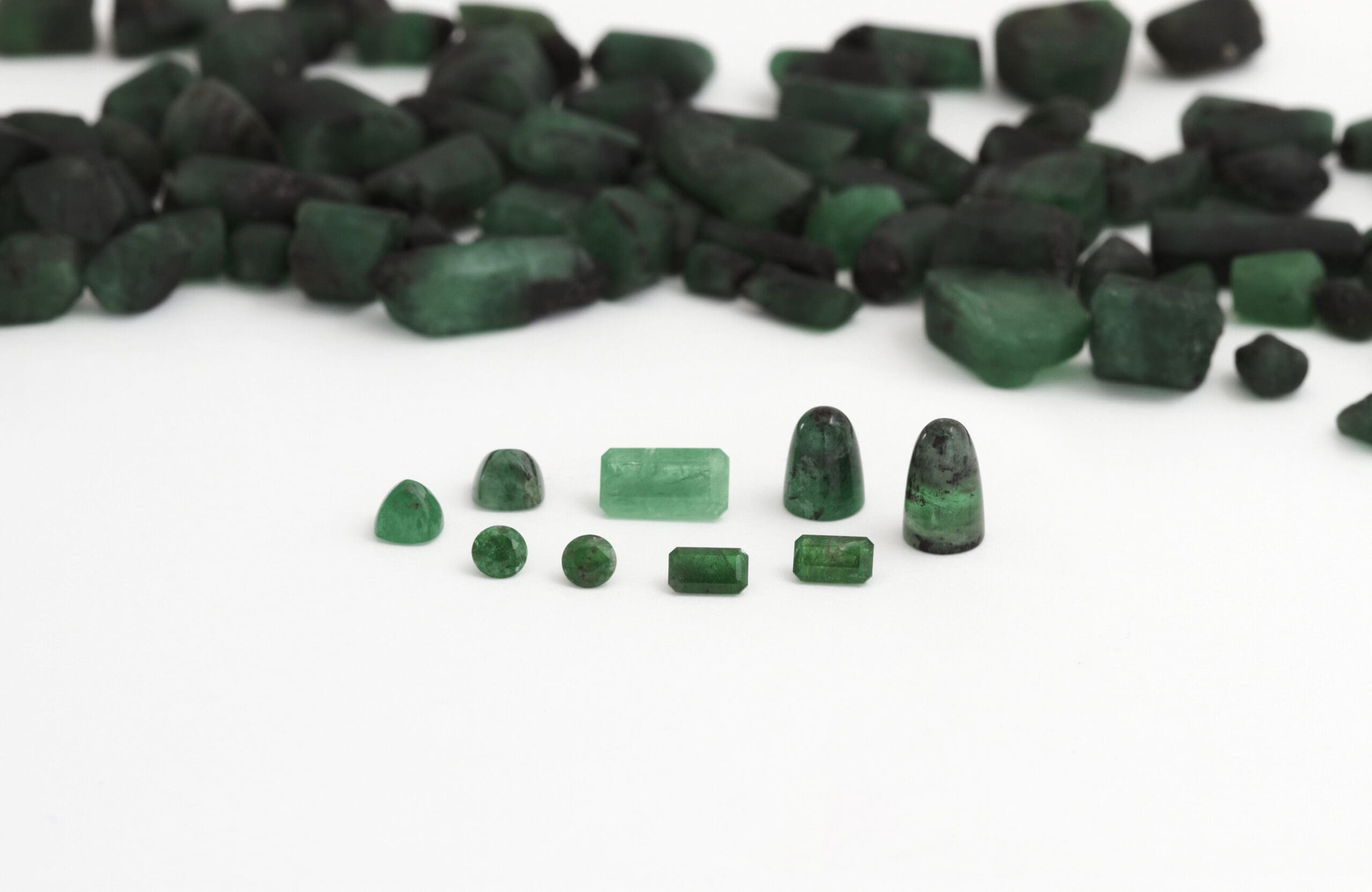
Cleopatra was obsessed with emeralds, and it’s not hard to see why! In fact, the earliest emerald mines originated in ancient Egypt around 330 BC. Ancient Egyptians thought of emeralds as symbols of life and fertility.
Colombian emeralds were highly sought after and frequently traded by Spanish explorers, which is why we see so many emeralds in European, Ottoman, and Asian royal jewelry.
In Hindu teachings, emeralds are associated with the planet Mercury and are one of the nine gemstones featured in the “Navaratna” style.
Emeralds were thought to be soothing to the eyes, so much so that gemcutters used to keep emeralds on their workbenches to look at after a long day of work faceting other types of gems.
Today, emeralds are associated with new beginnings, peace, and loyalty. Their lush color and association with newness led to it becoming the birthstone for the month of May.
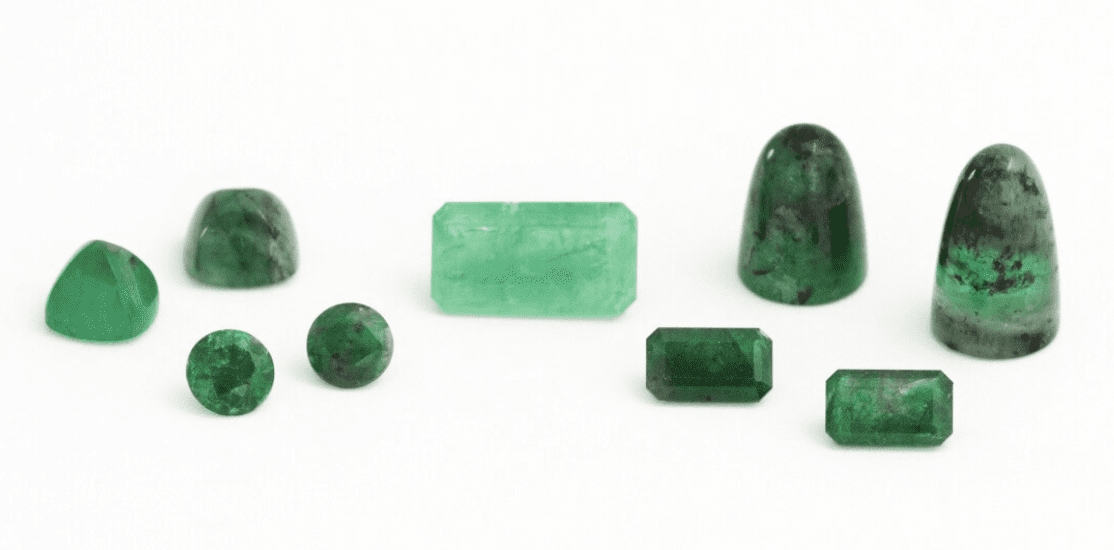
Emeralds are mostly found in Zambia, Zimbabwe, Colombia, and Brazil. However, they can also be found in other East African countries such as Tanzania. The most highly prized emeralds are from Colombia, Zambia and Brazil.