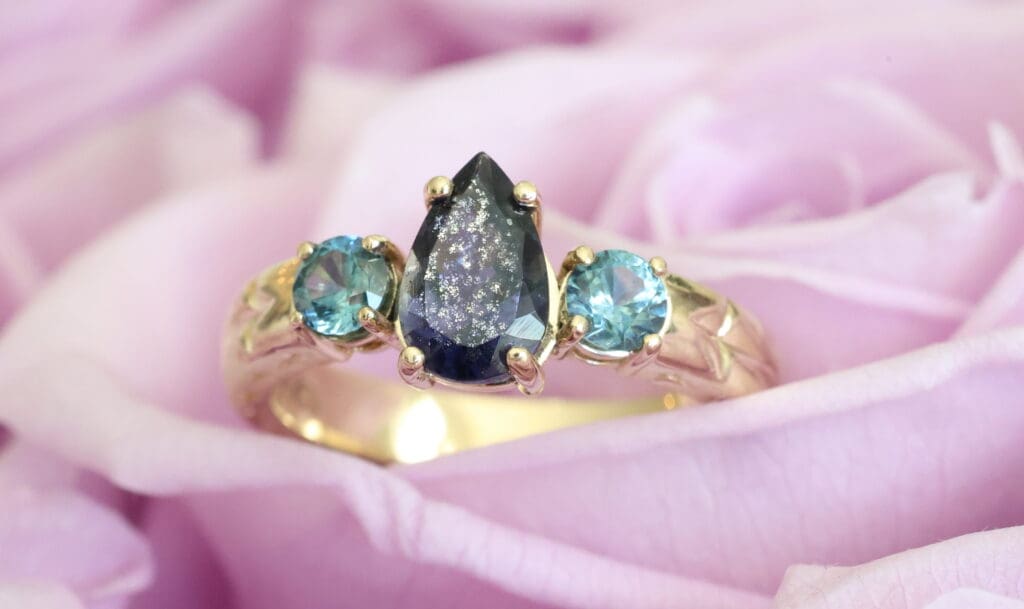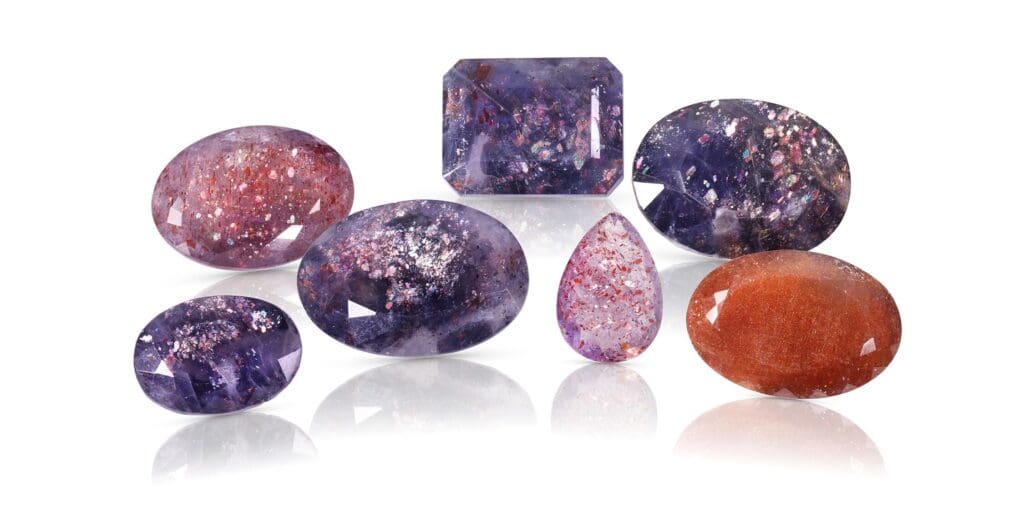
When I (Chloe) first saw this gem about a year ago, it completely stopped me in my tracks! I had seen regular sunstone and regular iolite, both gorgeous gems in their own right. Yet, somehow after years of being in the jewelry industry, I had never heard of or seen “Sunstone Iolite” before!
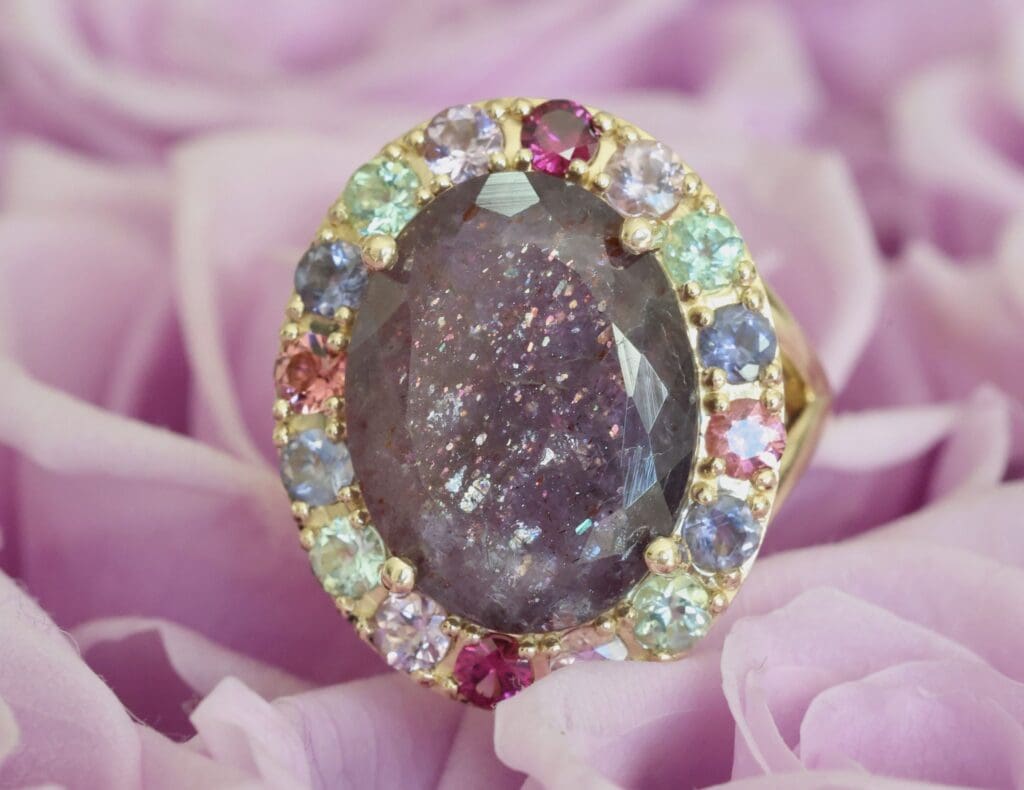
The gem is so named due to the fact that it is Iolite with hematite inclusions that are also found in sunstone. Tilt the gem one direction and the inclusions look red, which also sparked the moniker, “bloodshot iolite.” We like the name Sunstone Iolite much better!!
The flashes of teal, pink, green, orange, yellow and silver that you see when you tilt each gem just right is what made me fall in love with this gem and began my quest to find more and learn more about it!
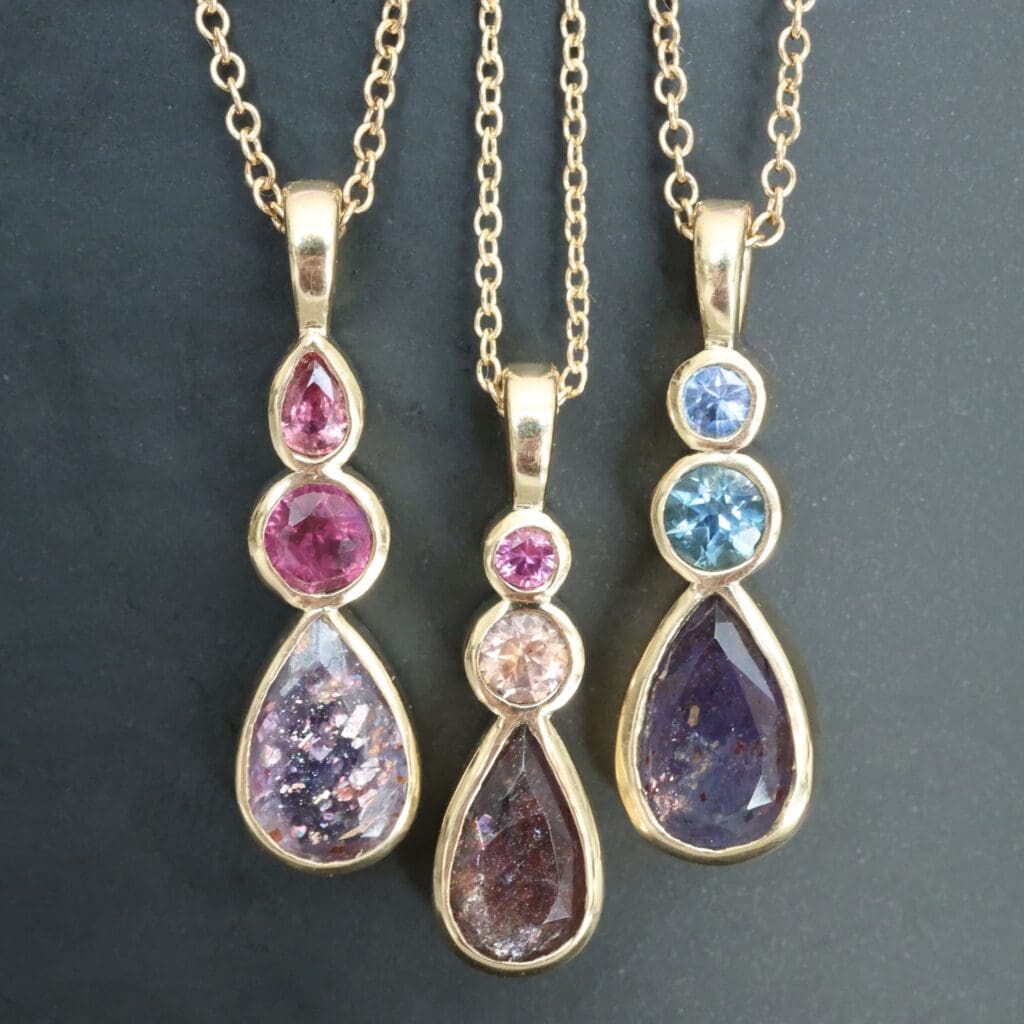
Reason #2 why Sunstone Iolite is underrated: each one is entirely unique, just like snowflakes!
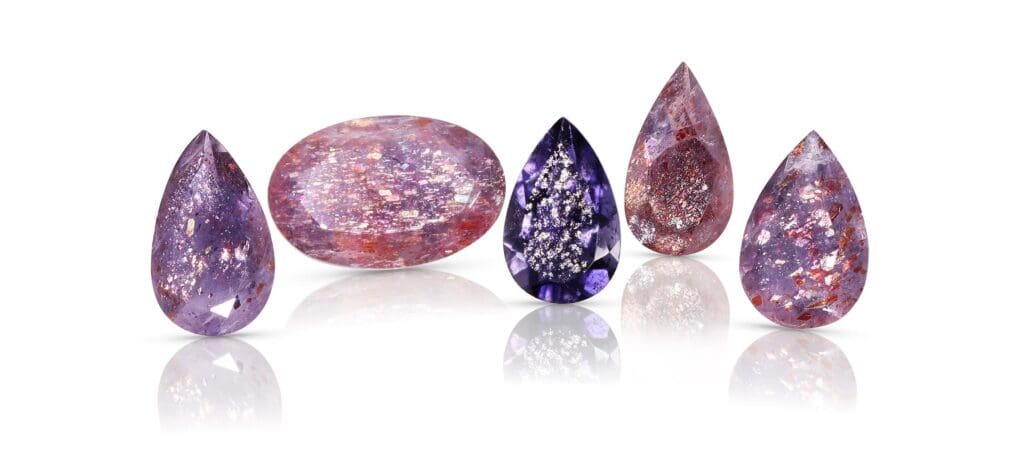
You’ll never see two sunstone iolites that are exactly the same, due to the way the inclusions are randomly dispersed and vary in color. Some sunstone iolites, which I like to call the “Midnight Sky” versions, only have silvery inclusions. Others, like the oval and the other pears you see above, have hematite inclusions that give off a rainbow of colors. Some inclusions are more elongated, while some are more tiny and round!
You never quite know what you are going to get when you cut this gemstone rough, but we think each one is full of its own allure and interest. We sourced the five in the compilation above from Laura of Tatum Gems in Australia. So far, three of the pears she cut ended up in Chloe’s “Starburst” pendants in 14kt Fairmined yellow gold which comes from certified mines in Colombia and Peru. How amazing is it when you can know not only where the gold in your piece came from, but who cut the gemstone?!
Reason #3 why Sunstone Iolite is underrated: it’s quite rare!
Now that you’ve (hopefully) gotten to gawk at the beauty of these gems, it’s time to get into where they come from!
According to both GIA (the Gemological Institute of America) and Gem-A (The Gemological Association of Great Britain) sunstone iolite comes from both Tanzania and South India.
More specifically, the Tamil Nadu region of India and outside of Arusha, Tanzania.
In an article published by Gem-A, graduate Nishka Vaz marveled at the hematite inclusions and stated, “unlike sunstones, each hematite platelet in a bloodshot iolite reflects a different color, giving rise to a colorful spangled effect.”
Regular sunstones (plagioclase feldspar) and iolites (cordierite) are not too rare, but it IS rare to have them mix in this way to make sunstone iolite!
When I (Chloe) was searching for this gemstone last year in Tucson, I was looking for sunstone iolite in any form I could find it in. In one bead show called the Holidome, out of the giant football-field sized tent of vendors, only one vendor had beads of this stone, and one other vendor had faceted cuts of it. So, you do the math, out of thousands upon thousands of vendors that sell at Tucson every year, I only saw the gem twice!
Now, to be fair, it’s impossible to go to every single show in Tucson. Next year at Tucson 2027, I’m going to see if I can find it in any more places! It’s the best treasure hunt of all time.
I hope you have enjoyed learning more about this fantabulous gemstone, and are excited to check out the first five Cosmic Compass pieces when they drop on our site November 8th!